2026 Electrical Contractor Overhead and Profit Guide

What if winning your biggest bid of the year was actually the worst thing that could happen to your business? It sounds backwards, but for many in the trade, a successful estimate is often just a fast track to a cash flow crisis. This happens when you haven’t mastered calculating overhead and profit for electrical contractors. You know the feeling of finishing a grueling project, looking at the final check, and wondering where the money went. You worked hard, the installation is flawless, and the client is happy; yet, your net profit is nowhere to be found. It’s exhausting to watch rising material costs and labor burdens eat your lunch while you’re stuck using the same standard markup you’ve used for years.
I’m here to help you stop the bleeding and replace that stress with the security of a modern, reliable system. You’ll learn the exact formulas used by the most profitable shops to protect their longevity. We’ll break down the dangerous confusion between markup and margin, identify your true cost of doing business, and provide a repeatable framework for O&P. By the end of this guide, you’ll have the mathematical defense you need to ensure every bid you win actually puts money in your pocket.
Key Takeaways
- Stop guessing about indirect costs and learn to identify the “elemental” overhead that exists regardless of your current project load.
- Follow a repeatable formula for calculating overhead and profit for electrical contractors so your bids finally reflect your true cost of doing business.
- Break the habit of using simple markups and start using the margin formula to protect your cash flow from rising material and labor costs.
- Set sustainable profit targets for 2026 and learn how to adjust your numbers for high-stakes, complex industrial work.
- Learn how to reduce your permanent overhead by choosing tools that prioritize total ownership over endless monthly subscription fees.
Defining Overhead and Profit in Electrical Contracting
To truly master your business, you have to look at overhead at its most basic, “elemental” level. These are the costs that haunt your bank account even if every van is parked and no one is pulling wire. It’s the rent, the basic utilities, and the insurance premiums that don’t care if you have a backlog or a dry spell. Many contractors get into trouble because they only think about project-specific costs. However, calculating overhead and profit for electrical contractors requires you to account for these invisible drains first. If you don’t, you’re essentially paying the customer to let you do their work. It’s a fast way to go broke while staying busy.
Then there’s the critical distinction between direct and indirect costs. Direct costs are the obvious ones: wire, conduit, and the journeyman’s hourly rate. Indirect costs are the “gray area” items like small tools, fuel, and mobilization.
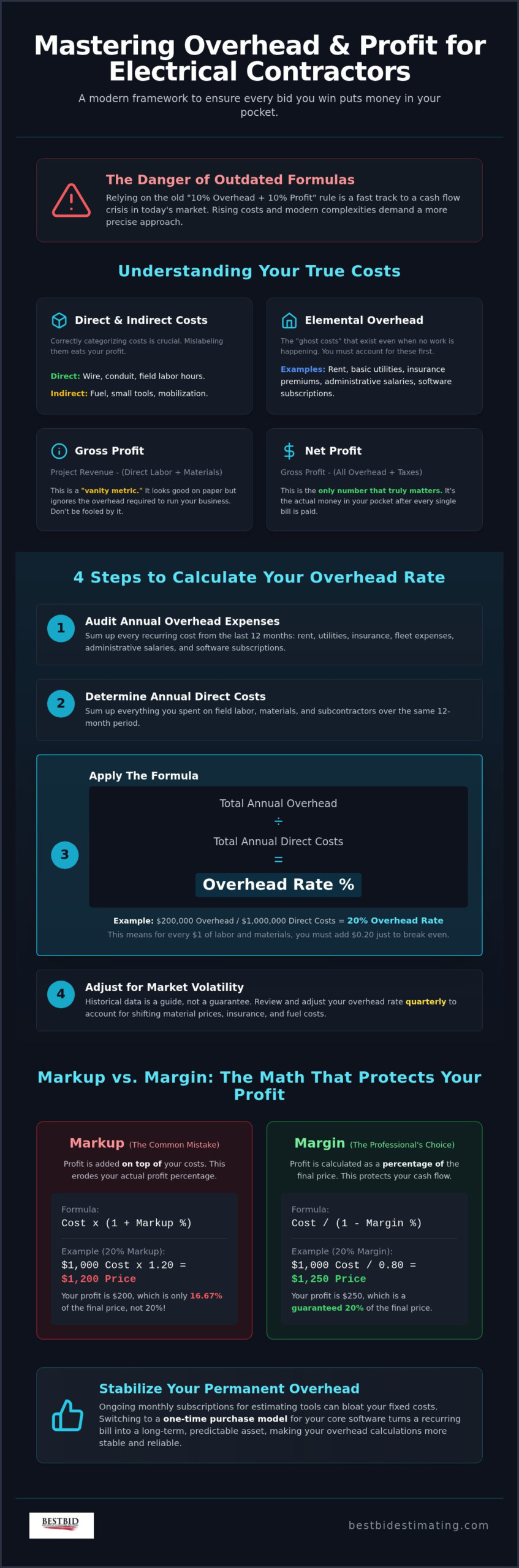
If you mislabel an indirect cost as overhead, you underprice the specific job. If you forget to include it at all, it eats your profit. Relying on the old “10-and-10” rule (10% for overhead and 10% for profit) is a dangerous relic in 2026.
With current inflation and the complexity of modern electrical systems, 10% rarely covers the actual cost of keeping the lights on, let alone leaving room for business growth.
Common Electrical Overhead Categories
Your overhead isn’t just one big lump sum. It’s made of specific categories that need constant monitoring to keep your bids competitive:
- Administrative salaries: The people who handle the billing, permits, and scheduling.
- Fleet expenses: This includes vehicle maintenance, specialized insurance, and the ever-fluctuating cost of fuel.
- Technology and Software: This is a major leak for many shops. Ongoing monthly subscriptions for estimating tools can bloat your permanent overhead rate. Switching to a one-time purchase model like Best Bid Next Generation helps you turn a recurring bill into a long-term asset.
The Difference Between Gross and Net Profit
Confusion here is why some contractors have a high volume of work but an empty bank account. Gross profit is simply what’s left after you pay for the labor and materials on a specific project. It looks great on paper, but it’s a “vanity metric.” Net profit is the only number that actually matters. It’s the real money left over after every single bill, tax, and overhead cent is paid. Calculating overhead and profit for electrical contractors correctly ensures that your net profit is a deliberate choice, not just a lucky accident at the end of the month. Tracking net profit allows you to see the true health of your company and decide when it’s time to scale or tighten the belt.
How to Calculate Your Overhead Rate: A Step-by-Step Guide
How do you turn a pile of receipts and bank statements into a winning bid? It starts with a cold, hard look at your books. When you’re calculating overhead and profit for electrical contractors, you can’t afford to guess. You need a repeatable process that accounts for every cent leaving your business before you ever step foot on a job site.
Step 1 is auditing your annual overhead expenses, also known as your “burn rate.” Look at every recurring cost from the last twelve months. This includes the obvious things like office rent and the not-so-obvious ones like the software subscriptions that quietly renew every month. If you’re tired of those monthly drains, switching to a one-time purchase model for your electrical estimating software can help stabilize this number.
Step 2 requires you to determine your total annual direct costs. Sum up everything you spent on field labor, materials, and subcontractors over the same period. These are the costs directly tied to producing work.
Once you have these two totals, Step 3 is applying the formula: divide your total overhead by your total direct costs. If your overhead is $200,000 and your direct costs are $1,000,000, your overhead rate is 20%. This means for every dollar of material and labor you bid, you must add 20 cents just to break even.
Finally, Step 4 is adjusting for 2026 market volatility. Historical data is a guide, not a crystal ball. With material prices shifting rapidly, you should review your overhead rate quarterly.
If your fleet insurance or utility costs spiked in the last three months, your old rate is already obsolete. Don’t let 2025 numbers sink your 2026 profits.
Fixed vs. Variable Overhead
Fixed overhead stays the same whether you’re running ten crews or two. Rent, base salaries for office staff, and debt payments are permanent fixtures. Variable overhead, however, scales with your volume.
Think about fuel, small tool replacements, and job-site cell phone plans. As your firm grows, your variable costs will climb. Forecasting these requires looking at your project pipeline and estimating how much extra “support” each new contract will demand from your home office.
The Danger of Underestimating Labor Burden
Labor burden is the total cost of an employee beyond their hourly wage. Many contractors mistake this for simple overhead, but it’s a specific indirect cost that can fluctuate wildly. You have to account for payroll taxes, workers’ comp, health benefits, and even “non-productive” time like safety meetings or travel.
If you only bid the journeyman’s hourly rate, you’re losing money the moment they clock in. Treat labor burden as a distinct multiplier to ensure your labor costs are fully recovered on every invoice.
Markup vs. Margin: The Math That Protects Your Bottom Line
Have you ever finished a project only to realize your bank balance didn’t grow as much as your spreadsheet predicted? This usually stems from a fundamental error in calculating overhead and profit for electrical contractors: the markup trap. Many contractors use these two terms interchangeably, but doing so on bid day is a recipe for a cash flow crisis. If you add a 20% markup to your costs, you aren’t actually making a 20% profit. You’re making significantly less. Understanding this distinction is the difference between a business that merely survives and one that scales with confidence.
The trap is simple math. Markup is a percentage of your costs, while margin is a percentage of your total sales price. When you pay your overhead bills, you pay them out of your total revenue, not your markup.
If your project costs are $10,000 and you want a 15% net profit, adding a 15% markup ($1,500) brings your bid to $11,500. However, when you divide that $1,500 profit by the $11,500 total, your actual margin is only 13.04%. You just “lost” nearly 2% of your profit before the first van even left the shop.
To hit a true 15% margin, you must divide your costs by the inverse (0.85), which results in a bid of $11,764.71.
The Mathematical Breakdown
To keep your business healthy, you need to memorize two simple formulas. Use markup to determine how much to add to a specific cost, but use margin to ensure your total business health is protected:
- Calculating Markup: (Price – Cost) / Cost
- Calculating Margin: (Price – Cost) / Price
Use this quick reference table to see how much markup you actually need to hit your target margin:
| Target Margin | Required Markup |
|---|---|
| 10% | 11.1% |
| 15% | 17.6% |
| 20% | 25.0% |
| 25% | 33.3% |
Why Margin is the King of Metrics
Margin is the only metric that guarantees your overhead recovery is built into every dollar that enters your company. When a General Contractor asks why your price is higher than a competitor, you can confidently explain that your pricing model accounts for the total cost of doing business and project risk. It’s much easier to defend a “15% margin” than a “20% markup” because margin directly relates to the sustainability of the project. If you want to stop doing manual math on every bid, check our pricing for software that handles these calculations automatically. By focusing on margin, you ensure that your business stays profitable enough to provide the high-quality service your clients expect.
Setting Sustainable Profit Targets and Managing Risk
Setting a target isn’t just about picking a random number. It’s about sustainability. In 2026, a healthy net profit margin for most electrical subcontractors often lands between 4% and 7%; however, this is your starting line, not your finish line. When you’re calculating overhead and profit for electrical contractors, you have to factor in a “Risk Premium.” A high-stakes industrial job with rigid deadlines and specialized equipment requires a higher margin than a standard commercial build. If you don’t charge for that extra risk, you’re essentially gambling with your company’s future. You aren’t just selling wire and labor; you’re selling your ability to manage complex variables.
Project duration also dictates your O&P strategy. Long-term projects tie up your cash and your bonding capacity for months or years. If a job takes 18 months, your overhead recovery must account for potential labor rate hikes and material price jumps during that window. Don’t forget the “small” things that add up and kill margins. I’ve seen too many contractors lose their entire profit because they forgot to include permit fees, temporary power for the site, or final cleanup costs. These aren’t overhead; they’re job-specific direct costs that must be captured during the initial estimate. Precision in calculating overhead and profit for electrical contractors means looking at the total scope, not just the blueprints. For those managing high-stakes industrial contracts, you can visit forProject Technology to learn how Earned Value Management tools help track performance and protect your bottom line.
Steve Griffin’s ‘Lessons from the Trenches’
Steve Griffin, with over 50 years in the trade, often warns against “buying” a job. This is when you slash your O&P just to beat a competitor’s price. It’s a fast track to business failure. Instead of chasing the lowest bid, focus on relationship building with GCs who value reliability and quality. When you provide an accurate, transparent estimate, you build trust that pays better than any low-ball bid ever will. You can learn more about Steve’s philosophy in our Online School for Electrical Estimating, where we teach you how to bid for profit, not just for volume.
Contingency vs. Profit
There’s a massive difference between your profit margin and a contingency fund. Contingency is for the “unknowns,” especially in renovation work where you don’t know what’s behind the drywall until you start demo. This money belongs to the project, not your bottom line. If you treat contingency as profit, you’ll be left with nothing when a surprise change order arises. Protect your actual net profit by managing scope creep aggressively. Ensure every unapproved change is documented and billed separately so your original margin stays intact. If you’re ready to stop guessing and start winning, explore how Best Bid software can help you build these protections into every estimate.
How Accurate Estimating Software Stabilizes Your Overhead
Software is often treated like a utility bill; it is just another monthly drain you have to pay to keep the doors open. However, when you are calculating overhead and profit for electrical contractors, every recurring subscription fee actually raises your break-even point. This is what we call “subscription fatigue.” If you are paying for an estimating tool, a separate takeoff software, and a monthly pricing service, you are bloating your fixed overhead before you even win a job. We believe software should be an asset you own, not a permanent liability on your balance sheet.
The Best Bid advantage is built on a simple, fair philosophy: one-time purchase fees. By eliminating monthly subscriptions, you effectively lower your long-term overhead rate. Our systems include built-in onscreen takeoff (OST), which means you don’t need to juggle multiple licenses or export data between clunky programs.
This integration doesn’t just save money; it protects your margins from the “death by a thousand cuts” caused by forgotten fees and software price hikes. When your tools are stable, your bids are more predictable.
Reducing the ‘Cost to Estimate’
Every hour you spend staring at a screen is an overhead cost. If a complex bid takes you twenty hours to complete manually, that is twenty hours of administrative labor that must be recovered. You can significantly lower this “cost per bid” by using a faster, more intuitive workflow. Our tools reduce the number of clicks and automate the tedious parts of the job, such as counting conduit and wire lengths. To see this in action, explore the fastest workflow with Best Bid Next Generation. Speeding up your takeoff process allows you to bid more work without increasing your office staff, directly improving your company’s efficiency.
Accuracy as Profit Protection
Errors in data entry are the silent killers of net profit. A single misplaced zero or a missed material update can turn a winning bid into a massive loss. We protect your numbers with 1-click backups and fast transfer capabilities that prevent these manual mistakes. Integration with NetPricer ensures that your “Cost” basis is always current, reflecting real-time market shifts before you ever add your O&P. Calculating overhead and profit for electrical contractors is only effective if the underlying data is accurate. By owning your database and software for life, you build a foundation of precision that turns every project into a predictable source of income.
Take Control of Your Bottom Line in 2026
Mastering the math behind your business is the only way to ensure your hard work translates into actual wealth. You’ve seen how the markup trap can quietly drain your bank account and why calculating overhead and profit for electrical contractors requires a deliberate, margin-focused approach. By identifying your true “burn rate” and protecting your bids with a risk premium, you move from just winning jobs to building a sustainable legacy. Don’t let outdated manual processes or rising material costs dictate your success. It’s time to treat your estimating tools as an investment in your future rather than a recurring monthly burden.
Our software is built on over 50 years of trade experience to help you bid with total confidence. With a one-time purchase fee and built-in OST included, you can eliminate the stress of recurring subscriptions forever. Stop paying monthly overhead for your software; Own Best Bid Next Generation today! You have the skills to do the work; now you have the formulas to make sure that work pays off for years to come.
Frequently Asked Questions
What is the typical overhead rate for a small electrical contractor?
Usually, a small shop sees an overhead rate between 20% and 35% of their direct costs. Smaller firms often have higher percentages because they lack the high volume needed to spread out fixed costs like rent, office staff, and insurance. It’s vital to track your specific “burn rate” rather than relying on industry averages. If you don’t know your exact number, you’re likely underpricing your work from the very start.
How do I calculate profit margin if my material costs are volatile?
Use real-time pricing integrations and the margin formula to protect your bottom line. Instead of adding a fixed dollar amount, divide your total costs by the inverse of your target margin. This ensures that even if copper or conduit prices spike, your profit percentage remains stable. Frequent price updates are essential in 2026 to keep your estimates accurate and your electrical business healthy and sustainable.
Is a 10% overhead and 10% profit margin enough to stay in business?
No, the “10-and-10” rule is often a recipe for bankruptcy in the modern market. Most electrical contractors find that 10% doesn’t even cover their actual office rent, insurance, and administrative labor. By the time you pay your taxes and business expenses, a 10% profit often disappears entirely. You need a more realistic approach to calculating overhead and profit for electrical contractors to ensure you actually keep your money.
What is the difference between markup and margin in electrical bidding?
Markup is a percentage added to your costs, while margin is the percentage of the final selling price that is profit. Adding a 20% markup only results in a 16.7% margin. This mathematical gap is where many contractors lose their shirts. Always calculate your bids based on the desired margin to ensure your overhead is fully recovered and your net profit is guaranteed at the end of the month.
How does estimating software help in calculating overhead and profit?
Good software automates the complex math and ensures no indirect costs are forgotten. Tools with built-in OST and real-time pricing updates allow you to see your exact break-even point before you add a single cent of profit. By using a system that doesn’t require a monthly subscription, you also keep your permanent overhead lower. This makes your business more competitive without sacrificing your personal take-home pay or company growth.
Should I include my own salary in the overhead calculation?
Yes, you must include a fair market salary for yourself in the overhead if you handle administrative or management tasks. Many owners make the mistake of “living off the profit,” but profit is for business growth and risk, not your mortgage. If you don’t account for your own time as a cost, your overhead rate is artificially low. This leads to underpriced bids and a business that can’t survive without you.
How do I recover overhead on change orders?
Apply your full overhead and profit percentages to every change order, just as you would on the original bid. Change orders often require more administrative time and coordination than the initial work. If you only bill for the extra wire and labor, you’re losing money on the management of that change. Be transparent with the GC about these costs to protect your company’s financial health and long-term stability on the job site.
Can I use the same O&P percentages for residential and commercial work?
No, residential and commercial projects have very different risk profiles and administrative burdens. Residential work often involves more “windshield time” and smaller material orders, which can drive up your overhead per job. Commercial work might have lower overhead percentages but requires a higher risk premium for complex coordination. Calculating overhead and profit for electrical contractors means adjusting your numbers based on the specific demands and risks of each sector.