Electrical Estimating Software: How to Balance Cost vs. Capability
Why Complexity Kills Electrical Estimating Software — And What Usability Really Means
The most complex software is not the most powerful. Steve Griffin explains why usability beats features every time in electrical estimating.
Section 3: Complexity vs. Usability
“How complicated should I make it?” This question seems simple, but it isn’t. In fact, it’s one of the hardest questions in software design — especially in electrical estimating software.
Electrical contractors come from all backgrounds. Some are extremely tech savvy, comfortable with complex interfaces, and eager for advanced features. Others are old school, practical, and want the software to be as simple as possible.
Some estimate every day. Some estimate once a month. Some are detail oriented.
Some want the software to think for them.
If the software is too complex, users get frustrated. They feel overwhelmed. They feel lost.
They feel like the software is fighting them instead of helping them. They feel like they need training just to do basic tasks. They feel like the software is slowing them down.
If the software is too simple, users feel limited. They feel restricted. They feel like the software doesn’t do enough.
They feel like they have to do too much manually. They feel like the software is missing important features. They feel like the software is holding them back.
Balance is the art of giving the user power without burying them in complexity.
Software must:
- Do as much as possible automatically
- Stay simple enough for the average contractor
- Allow advanced users to go deeper
- Protect inexperienced users from mistakes
- Avoid overwhelming the user with options
Complexity is not the enemy. Unnecessary complexity is.
The best software feels powerful without feeling heavy. It feels capable without feeling complicated. It feels flexible without feeling chaotic. It feels like it was designed by someone who understands the work — not someone who just understands programming.
One of the biggest mistakes software companies make is designing for themselves instead of designing for the user. Developers love complexity. They love options.
They love settings. They love customization. They love advanced features.
They love power.
But estimators? Estimators love speed. Estimators love clarity.
Estimators love simplicity. Estimators love reliability. Estimators love accuracy.
Estimators love tools that help them think less, not more.
Balance is designing software that feels natural to the estimator — not to the developer.
Another mistake is assuming that more options equal more power. In reality, more options often equal more confusion. More options equal more decisions.
More options equal more thinking. More options equal more mistakes. More options equal more training.
Balance is choosing the right options — not all options.
The best software makes smart decisions for the user by default. It chooses the right quantities. It chooses the right materials.
It chooses the right assemblies. It chooses the right labor. It chooses the right structure.
It chooses the right path.
And then — only when needed — it allows the user to override those decisions.
This is balance.
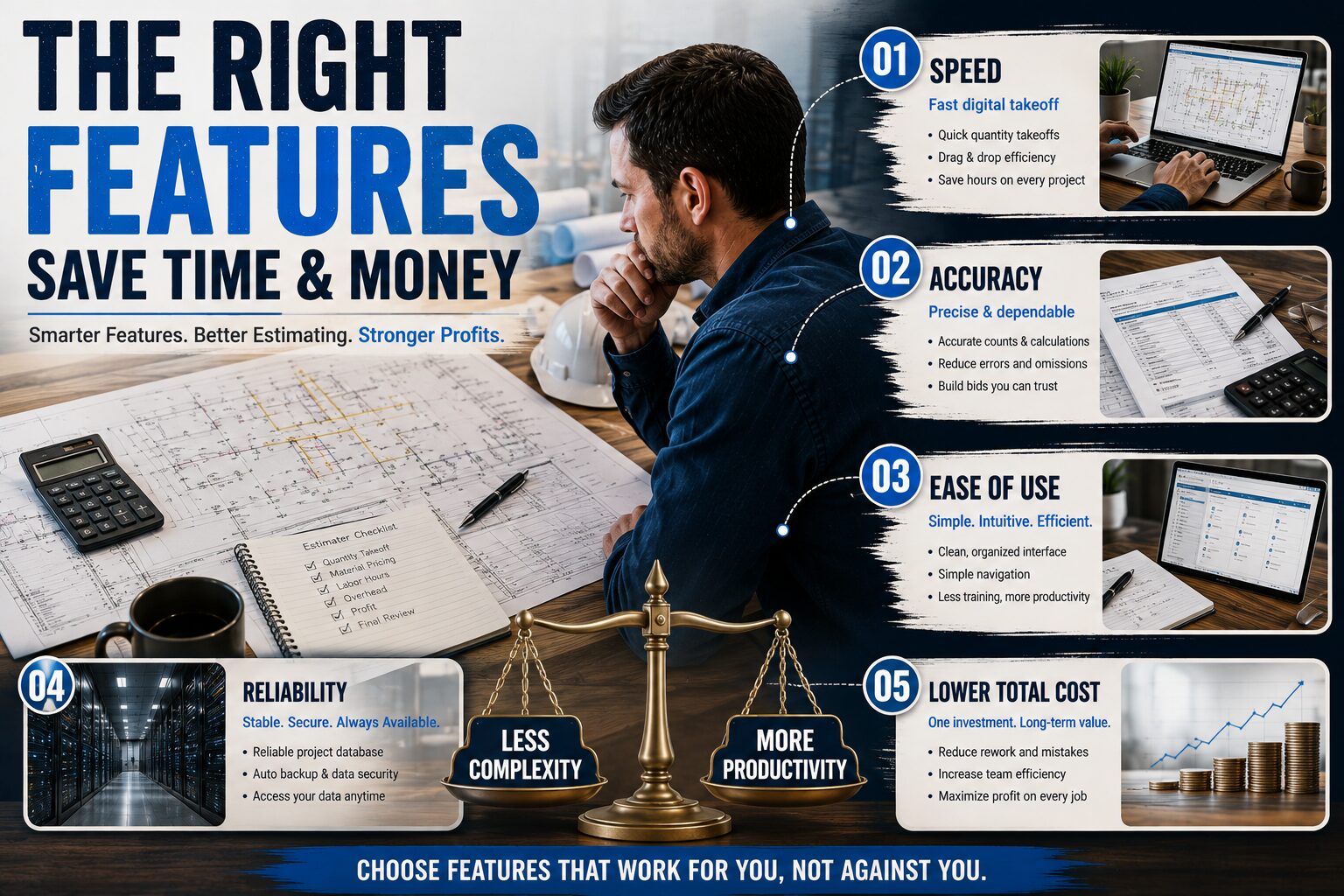
The software should feel like a partner, not a puzzle. It should feel like a tool, not a test. It should feel like an assistant, not an obstacle. It should feel like it understands the estimator’s workflow, not like it forces the estimator into a new workflow.
Balance is designing software that adapts to the estimator — not software that forces the estimator to adapt to it.
Key Principle
This principle is one of 30 that together form a complete philosophy of electrical estimating built from 50 years of real-world experience. Every principle connects to every other. Read the full guide to see how they work together.
Frequently Asked Questions
Complete Series Navigation


 Electrical contractor reviewing project costs after winning a construction bid