Steve Griffin, Author at BestBid Estimating 36

Entries by Steve Griffin

Efficiency Unleashed: A Deep Dive into Hybrid Pro Estimating Software

Staying ahead of the curve in electrical project estimation is crucial for success. With technology continuously evolving, professionals in the industry need advanced tools to streamline their processes, enhance accuracy, and boost overall efficiency. The answer to these demands lies in the revolutionary “Hybrid Pro Estimating Software” – a game-changer that promises to take electrical Read more about Efficiency Unleashed: A Deep Dive into Hybrid Pro Estimating Software

Powering Up Precision: Choosing the Right Electrical Bidding Software

Have you ever found yourself in a tight spot regarding electrical estimations? Balancing precision and efficiency can be quite a high-wire act. If you’ve ever pondered these challenges, you’re in for something that will change how you look at Electrical Bidding. We’re about to explore Electrical Bidding Software, and it’s not your typical guide. It’s Read more about Powering Up Precision: Choosing the Right Electrical Bidding Software

Starting and Growing a Successful Green-Building Business

If you’re an aspiring business owner passionate about green building, now is the perfect time to get started. With the world transitioning towards more sustainable construction practices, there’s never been a greater need for green-building businesses. Electrical Bidding Software outlines how to get started. Getting Started To start, you must decide what eco-friendly business you intend Read more about Starting and Growing a Successful Green-Building Business

Bidding Brilliance: Exploring Features in Electrical Bidding Software

Think about the last construction project you bid on.

Did you wish there was a way to make the process smoother, faster, and more accurate? Well, you’re not alone.

Electrical Bidding software isn’t just another tool; it’s a game-changer and is here to make your life easier.

In this blog, we’ll show you how bidding estimate software can revolutionize your approach to project bidding, saving you time and money.

No more headaches, no more guesswork – just a streamlined, efficient bidding process that puts you ahead of the competition.

Understanding Electrical Bidding Estimating Software

Electrical Bidding Software is a critical tool in the construction industry, facilitating the estimation of project costs with a high degree of accuracy.

These software solutions are designed to automate and simplify the bidding process, offering a wide range of features tailored to the specific needs of construction professionals.

Key Features of Electrical Estimating Software

Streamline your bidding process and boost accuracy with Electrical Bidding Software for electrical operations.

Here are the key features of the software that you need to know about:

  1. Cost Database Integration

The software often has a comprehensive database of construction costs, materials, and labor expenses. This feature allows users to access up-to-date pricing information, saving time and reducing the margin for error when estimating project costs.

  1. Takeoff Tools

Accurate takeoffs are essential for precise cost estimation. Electrical Bidding Software includes advanced takeoff tools that enable users to measure quantities from digital blueprints and drawings, eliminating manual calculations and errors.

  1. Customizable Templates

Construction projects vary widely in scope and complexity. Electrical Bidding Software provides customizable templates tailored to specific project requirements. This flexibility streamlines the bidding process and ensures all relevant factors are accounted for.

  1. Integration with Project Management Software

Seamless integration with project management software enhances communication and collaboration among project stakeholders. This integration allows for the transfer of bid data to project management tools, reducing redundancy and ensuring that the estimated costs align with project budgets.

  1. Historical Data Analysis

It can analyze historical bid data, helping users identify trends and patterns in past projects. This data-driven approach aids in making more informed decisions when preparing bids and forecasting project costs.

  1. Real-Time Collaboration

Collaboration is a key aspect of successful project management. Many Electrical Bidding Tools offer real-time collaboration features that allow multiple team members to work on the same bid simultaneously. This enhances efficiency and reduces the risk of errors.

  1. Cost Comparison

It enables users to compare multiple cost scenarios quickly. By adjusting variables such as materials, labor rates, and project scope, professionals can assess the impact on project costs and make informed decisions.

Electrical Bidding Software

Benefits of Using Bid Estimating Software for Electrical Projects

Now that we have explored the key features, it’s important to understand the advantages of incorporating Electrical Bidding Software into your workflow.

Some major benefits you should be aware of are:

  • Accuracy: Electrical Bidding software significantly reduces the chances of human error, ensuring that project costs are calculated precisely.
  • Efficiency: Automating tasks like takeoffs and cost calculations speed up the bidding process, allowing professionals to submit bids faster and potentially win more contracts.
  • Cost Savings: Accurate cost estimation helps avoid overestimation or underestimation, ensuring that projects are financially viable.
  • Data-Driven Decisions: Historical data analysis provides valuable insights that enable data-driven decision-making for future projects.
  • Competitive Edge: Efficient and accurate bidding can give your company a competitive advantage in the construction industry.
  • Collaboration: Real-time collaboration features foster better communication among team members, reducing misunderstandings and delays.

Electrical Bidding Software

FAQs About Electrical Bidding Software

Q1. Is the electrical bidding software suitable for small construction businesses?

Yes, it can be tailored to the needs of both small and large construction businesses. Many solutions offer scalable features to accommodate varying project sizes.

Q2. Can Electrical Software for Bidding be integrated with accounting software?

Yes, many bid estimating software solutions for electrical projects offer integration with popular accounting software, making it easier to manage project finances.

Q3. Are estimating software solutions compatible with mobile devices?

Most Electrical Bidding Software offers mobile apps or responsive web interfaces, allowing users to access their tools and data on smartphones and tablets.

Q4. What is the learning curve for estimating software?

The learning curve for Electrical Bidding Software varies depending on the complexity of the tool and the user’s familiarity with construction estimating. However, many software providers offer training and support to help users get started.

Q5. Can bid estimating software for electrical projects be used for other industries besides construction?

While estimating software is primarily designed for construction, its principles and features can be adapted for other industries that require project cost estimation.

Key Takeaways

Electrical Bidding software isn’t just a tool; it’s the key to unlocking a smoother, more efficient way of working.

So, what’s the next step in this exciting narrative? It’s action – plain and simple.

Integrate estimating software into your workflow, and watch as your bidding strategy becomes more streamlined and competitive. No more guessing games, just precision and clarity.

As technology evolves, keep an eye on future developments and trends in Electrical Bidding Software. Staying ahead of the curve will ensure you’re always at the forefront of industry innovation.

Take the plunge, adopt this tool, and witness your bidding prowess reach new heights.

Crew Size & Job Tracking

“You must have this free tool”

When you are new to Electrical Contracting and you first start thinking of crew sizes and how to keep track of your electrical projects, it may seem easy.

You may say we will work 8 hours a day 5 days a week. This gives you 40 hours per week allocated per worker. You may think of this as spending 40 Man-Hours per week for each employee that will be working on the project.

Another way to view this is to divide the total number of Man-Hours from your electrical estimate by 40 to see how many weeks it would take 1 man to complete the project…

For example: If your electrical estimate says it will take 400 Man-Hours to complete the project you would divide 400/40=10. This tells you that it would take 1 man 10 weeks or 50 days to complete the work.

This gives you an idea of what size project you are looking at.

Using this method of thinking, if you used 2 workers the math would be 400/80 so it would take 2 workers 5 weeks or 25 days.

Breaking this down, you could say if 4 workers are working, the math would be 4 workers x 8 hr. a day or 32 total hr. per day  400/32=12.5 days then 12.5/5=2.5 weeks.

You may also look at it like this: Let’s say that you have 400 Man Hours estimated from your electrical estimating software to do the project and the project duration is 25 days. You need to know how many hours per day that you will need to work to complete the project on time.

You would start by saying 400 total Man-Hours /25 days in the project. This would be 16 Man Hours that must be worked per day to complete the project in 25 days.  To check this you would say 16 x 25 = 400.

This information is great to check your Man-Hours against a project. For example: If you are bidding a project similar to another project that you have completed, it is wise to see how many Man-Hours were in the original project and how well it turned out.

 For example: If the original project took 30 days for 2 workers to complete, then you know it took 480 Man-Hours.   (16 x 30) = 480 MH

You can use 480 Man-Hours as a guide for the new project. If the new project estimate comes out to be 680 or 280 Man-Hours, then you may need to check the estimate.

This is a very simple way to check your electrical estimate. It is also only a partial view of the project.

Producing Crew Sizes for Larger Electrical Projects.

When you start estimating larger electrical projects you will find that there is more to consider.

There will be important factors to consider such as the following:

  1. How long is the project duration?
  2. How soon can you start to work on the project?
  3. If there is site work, can you start early or will you need to wait?
  4. What season will the project start? Weather is out of your control but if you are working in mud your production will be slower, so you will need to make that time up elsewhere.
  5. When will the building be in the dry so you can start working?
  6. How many days will be left to finish the project?

Additional things to consider:

  1. When are the walls going up?
  2. When does the drywall go up?
  3. When does the painting start?
  4. When will the ceiling being installed?

There is much to think about to get the best production.

  1. Will you need a lift?
  2. Can you do your ceiling work before the walls go up to utilize a lift?
  3. Will the slab be poured or will you need an all-terrain lift to move around?

Producing schedules to allocate your Man-Hours.

On larger Electrical Projects you will be producing a schedule to work by. Your schedule will change as you perform task faster or slower than predicted. Some projects you will be in control of your schedule but in most cases the General Contractor will create a schedule for the project and you will need to perform your task to meet pre-selected dates.

If you are lucky the General Contractor will either let you review the schedule to make changes or ask you to provide information pertaining to the time allowed for each phase of your work. You must review the electrical schedule closely and provide input or agree to the timeframes allocated for each phases of the project.

If you have the proper electrical estimate this task is easy and will pay dividends because you will know the Man-Hours you have allowed for each phase. The Best Bid Hybrid Pro performs this task perfectly.

Setting up your schedule

We will show you how to easily set up your electrical schedule.

You should look at the entire project and break it down so you can get the feel of the difficulty of completion. In time you will have a feel for the numbers but let’s create a mock project to show you the steps…

This project will be called Gadston Project Center. We know that the project duration will be 365 days.

To start with the project duration is given in total number of calendar days to complete the project.

A 365 day project will have several days that you will not work.

For example:
01. Holidays.
02. Weekends.
03. Weather delays.

You see that the project duration is 365 days but you will not have 365 days to complete your work.

To start with you must do your best to determine how many days you will actually have to work.

Things to consider will be when will you be able to actually start installing electrical work. There usually will be site prep, slab, steel erection, and other things going on that you may not be able to be on site.

We can start building the schedule once we determine how many days we will have actually have to work.

In this project here are the key points of information:

  1. The project has 365 total days to complete.
  2. You know you will not be on site the entire 365 days.
  3. Your electrical estimate shows 6000 Man-Hours to complete.
  4. You only have 6 employees that you can allocate to this project.

Creating a Mock Schedule

Let’s start by doing a mock schedule to see where we are.

From talking to the General Contractor this is the information we have received.

From this information we can see that we have about 196 days to work after the slab has been installed.

Our electrical estimate has 6000 Man-Hours.

Using the Crew Calculator we will enter 365 days and 6000 Man-Hours.

Now let’s review the entire project.

This view shows hours that need to be worked per day working 7 days, 6 days, and 5 days a week.
How many hours that must be worked per week and per month.

This is the example we are shooting for. 8 hours a day 5 days a week.

With this knowledge we see that this project is possible as long as we manage it correctly. It would take 3 guys if we could work the entire 261 days but from the schedule we know we can’t.

 Let’s look at the electrical estimate and the Man-Hours that are allotted for each phase.

To start your schedule so that you can tell the General Contractor the time that should be allowed for each phase follow the steps below.

Steps to create your schedule using the Crew Size Calculator.

For the site we have 220 man hours. The General Contractor has allotted 14 calendar days to complete.

In the Crew Size Calculator simply change the 6000 total man-hours to 220 and the total of 365 days to 14.

This shows that we could complete this task with 2 men +++If+++ we worked 7 days a week.

Let’s look at the chart with 5-8hr days.

From this view we know we can complete this task with 3 guys in the time allotted.

We will enter 3 days into the electrical schedule for this task.

Next we will repeat the process for the slab. We estimated 100 Man-Hours to complete the slab and the General wants to allow 4 days. Using the form place 100 total Man-Hours with 4 days to complete as shown below.

Since 4 days is less than a week we can use this chart. We will allocate 4 guys just to be safe.

We repeat this process for RI Walls.

We have estimated 960 Man-Hours for this portion of the project. The general is allowing us 30 days to complete this task.

From our chart we can accomplish this task with 6 guys. This is in our limit of 6 workers.

We are filling in the schedule. So far we do not have any issues.

We proceed with filling out the schedule in the same way.

Next is RI Branch and we have 1780 Man-Hours to complete the task. The general is giving us 35 days to complete this task.

To complete this task using only 6 men we will need to work 6 days a week 10 hours a day for 30 days.

Completing the rest of the schedule it will look like this:

With the schedule filled out you can see that we will be asking for 178 calendar days.

Remember from earlier we have.

There are 18 days to play with. You could ask for a couple more days on the RI and I am sure you could get them with this information.

This is the finished schedule.

The Crew Size Calculator is a very valuable tool to create quick budgets. It is also a fantastic way to track your electrical projects. Every electrical contractor should be using some tool to keep up with the project after it is won.

The Best Bid Hybrid Pro with On-Screen Takeoff will win you the project but now you need a tool like the Crew Calculator to keep the project on track.

The Crew Calculator will produce your Schedules, Track your jobs, keep your Quotes and Change Orders in order. It will also keep up with your inspections and job notes.

If you do not have a tool in place to manage these tasks, Best Bid is providing you this tool for “FREE”

To receive a FREE copy call Best Bid Electrical Estimating Software.

800-941-7028—–Ask for Steve

Keep track of your electrical Projects

Always know how many hours are left per task.

Print where the project is weekly

Keep up with your Quotes

Track Change Orders

Keep up with Inspections

Trust Your Man-Hours-Electrical Estimating Software

                                                          Trusting your Man-Hours

In estimating electrical projects, it is easier to know what material you will need vs how long it will take to install that material. With time or Man-Hours, there are many more variables to consider. Who is doing the installation can change the time that it takes dramatically. When I was 30, I could throw a bundle of conduit on each shoulder and run up 3 flights of stairs and not even be breathing hard. Moreover, if we needed to finish an area, we would work through break and get it done. The 50-year-old guys could not work as fast, but they had electrical knowledge that I didn’t.
If I try hard, I can remember way- back to when I first started doing electrical work. For the most part, we wired houses. In the early years you got paid for 8hr when you finished wiring a house. If you drug it out for two days, you still receive 8 hr. of pay. True, these were 1500 to 1700 sq. ft. homes, not the mega homes people build today and with the codes that we deal with today but, you had to run to make it happen. You learned to work.
On rare occasions, you would get a second person to help you. I noticed that even with a second person we didn’t get done in half the time. We were less tired, and we got finished faster but we never finished in ½ the time.
I learned from this that 2 people will not install twice as fast as 1 and, with 4 people, will not install twice as fast as two.
To sum it up, more men equals less production per man.
Here is another example of man- hour’s errors. My wife wanted me to install a window shade. I have already installed two of these blinds and the blinds were very easy to install. I kept putting this off because it was over one of my computer stations, and I would need a ladder. I kept telling her I would get it installed right after the game. It would only take a few minutes to install one blind, so there was no need to rush.


I went to get the ladder, and I remembered that the neighbor had borrowed it, so I drove over to his house to retrieve the ladder. Now I have my ladder and it only wasted a half an hour. Next I went to the shop and got my cordless drill and a bit that I needed to make the installation simple. I opened the blind and found the hangers, but there was a screw missing from the package. I went back to the shop to find a screw that would work and eventually, I had everything I needed to install the blind. I installed the two hangers and started to snap the blind in but something was off. I discovered that this window was 1” narrower than the windows on the front of the house, and this blind would not fit.
Now I am in real trouble because I have waited so long to do this installation that this style blind was no longer available in this color.
After much consideration, I took the blind back to my shop and carefully sawed off 1” with a band saw.
It actually worked. I took the blind back into the house and snapped it in the hangers, and in about 3-1/2 hours, the blind was installed.

The point of this story is: We always think everything is going to go perfectly. I can install this project in 4 weeks, then I have a man to quit and it takes 5 weeks.
Electrical estimating has to be a mix of thinking. If you think everything is going to go right you will bid too little. If you think everything will go wrong, you will never get a job.
Best Bid Electrical Estimating Software has the perfect mix of Man-Hours allotted to the material so you don’t have to do the hard thinking. We have done this for you. From NECA along with years of historical data, we have created a database of Man-Hours that flow smoothly taking into consideration a mix of young workers, older workers, apprentices, and journeymen so that every project has the correct labor.
We also can increase or decrease the Man-Hours for difficulty on each page of the estimate.
Getting your time correct is equally as important for your electrical estimates as getting your material correct.

Trusting pre-determined man-hours will get you much closer than guessing how long that job will take. Combine this with a little historical data and you will have a winning estimate.
What the takeaway from this blog is, that there can always be the unforeseen. A great Electrical Estimator Software can help overcome these obstacles. Estimating software for electrical projects is a must for any successful electrical contractor. Electrical estimating programs like the Best Bid Hybrid Pro have spent 30-plus years fine-tuning their labor units for electrical projects.
Learn to trust what the quoting software for your electrical projects produces for you. Feel free to modify your hours for difficulty but overall trusting your software will produce better results than you guessing.

How to make Electrical Estimating Easy

The easiest way to make electrical estimating easy is simple.

“Learn how to estimate”.

Stop guessing and stop trying to make it hard.

You don’t need to make estimating complicated. The goal is to provide a price that is low enough to win the project but inclusive enough that when the project is over you made money.


You have to accept that you can’t control your competition. Strive for the perfect bid for your company, and let the prices fall where they fall. The low bid is often not the best bid. You must be confident in your bidding. You should never start changing the way you bid as soon as you lose a couple of jobs. I have often had estimators call and ask about their bidding techniques after losing a few projects. These are the same estimators that have won millions of dollars of work year after year and are very successful. You must have faith in your skills to estimate. Some people call it guesstimation but in reality, a lot of the estimate isn’t guesswork at all but solid written-in-stone information. Remember losing a job does not necessarily mean that you bid it wrong. Find what works for you and stay with it. Trust the numbers.


When you sit down and dissect an electrical estimate you will see that there are only a few parts.

Lighting, Gear, Devices, Branch Lighting, Branch Power, Motor Feeders or all Home Runs, Panel Feeders, Low Voltage if any, other Quoted Items, and Miscellaneous.


how to make electrical estimating easy

The Takeoff

You will start with your Takeoff. In simple words, this is all of your counts and measurements.

Counting will consist of:


Lighting

Lighting Controls

Gear

Devices

Fire Alarm if any

Data/Phone/Security/ETC


This is something that can be achieved at 100%.

Even a non-electrician can count how many lights and devices there are on a drawing.


As far as the Takeoff goes everyone should see this step the same.

For example, all of your competitors should have the same number of A Type light fixtures and the same number of duplex receptacles as you do.


By counting all items until you get the same results twice you can be confident that ½ the Takeoff can be 100%.


I am skipping Branch Lighting and Branch Power for now and moving to motor feeders and panel feeders. These are performed the same way.

Let’s start with Panel Feeders

For the most part, estimators don’t seem to enjoy this section +++BUT+++ it is easy and should not be dreaded.

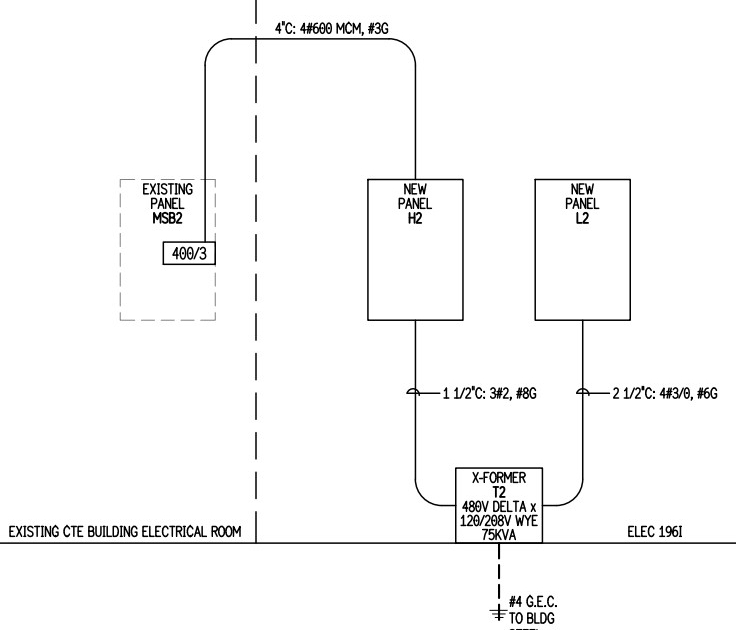
Just find the One-Line diagram.

You have already visited this sheet when you were counting your gear.

I start by writing down all of the feeders as they are shown.


This is a simplified One-Line but it works the same no matter how large the project is.

Example:

Existing Panel MSB2-400/3 to New Panel H2—4”C W/4-#600 MCM & 1-#3G

New Panel H2 to Transformer T2—1-1/2C W/3# 2 & 1-#8G

Transformer T2 to New Panel L2—2-1/2C W/4#3/0 & 1# 6G

#4 G to building steel.


You can also get Panel Feeders 100% but there is a couple more steps.


You must read the specifications to see the requirements such as Raceway types accepted, fitting types accepted, is ALU wire accepted as an alt etc.

What this means to you is will these runs be installed in EMT with set Screw fittings or GRS. Will you use Plastic Bushings or Grounding Bushings? Etc.

You should also decide how much conductor to include for termination. A general rule is between 15’ and 20’.

If you use the same adjustment you will not have to think about it.


After you have written down the distance of the Panel Feeders above you also need to include how many 90’s and in the case of the two transformers runs include flex.


For example;

Existing Panel MSB2-400/3 to New Panel H2—4”C W/4-#600 MCM & 1-#3G-1-LB-1-90-20’extra cond.

New Panel H2 to Transformer T2—1-1/2C W/3# 2 & 1-#8G 1-90-Flex-25’ extra conductor

Transformer T2 to New Panel L2—2-1/2C W/4#3/0 & 1# 6G 1-90-Flex-25’ extra conductor


This becomes a simple task when you attack it line by line.

Motor Feeders

Now let’s move on to Motor Feeders.

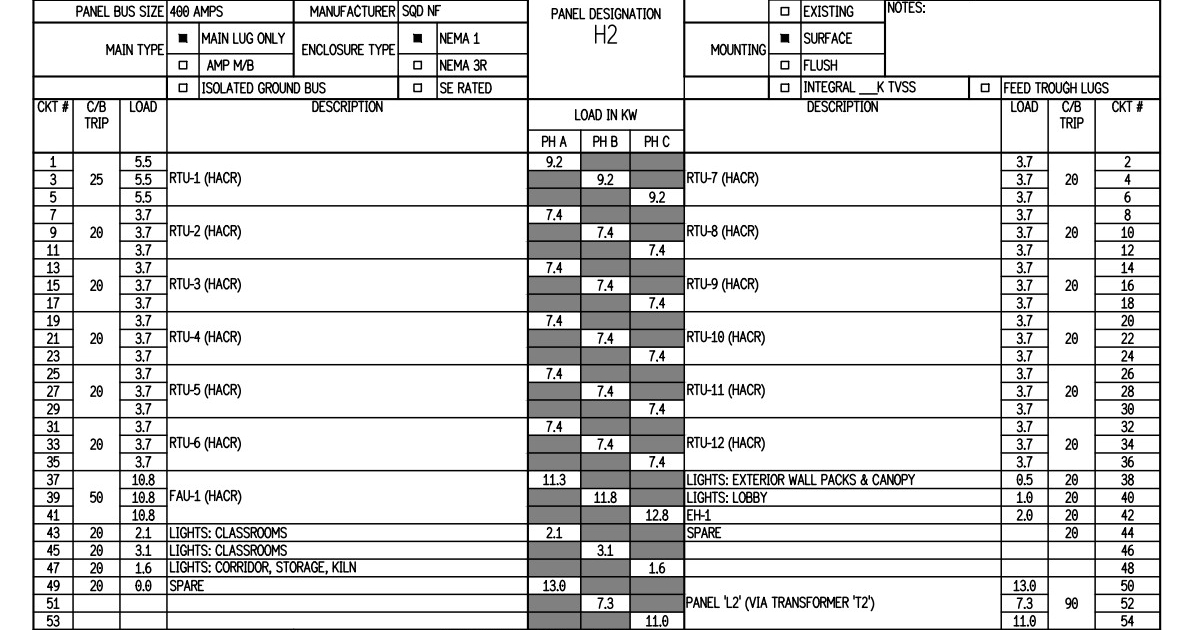
A simple hack to getting this right every time is to start with ALL of your panel schedules.

Without looking at the plans and trying to pick out all of the feeders it is easier to simply look at the panel schedules.


Write down all of the 2-pole and 3-pole items listed in the schedules.You now know that you will be covered because if there is a feeder there must be a breaker for it.

Looking at the schedule above we know we will be looking for

RTU-1

RTU-2

RTU-3

RTU-4

RTU-5

RTU-6

RTU-7

RTU-8

RTU-9

RTU-10

RTU-11

RTU-12

FAU-1

I also like to take note of the voltage, breaker size feeding the item, and the phase.

RTU-1-480V-25/3-3R

RTU-2-480V-20/3-3R

RTU-3 480-20/3-3R

RTU-4-480V-20/3-3R

RTU-5-480V-20/3-3R

 RTU-6-480V-20/3-3R

RTU-7-480V-20/3-3R

RTU-8-480V-20/3-3R

 RTU-9-480V-20/3-3R

 RTU-10-480V-20/3-3R

 RTU-11-480V-20/3-3R

 RTU-12-480V-20/3-3R

 FAU-1-480V-50/3-N1

From the information above I know the feeders that I must find. I also have a list of disconnects to check against. The final plus is just in case the feeders are not sized I have that recorded as well.

From this point all that is needed to do is find the item and record the distance.

We have addressed counting which is as easy as counting each item on the drawings, recording the Panel Feeders from the One-Line diagram, and Motor Feeders by taking these directly from the panel schedules.

So far there should not be any difference between you and your competitors Takeoff assuming that they took the time to get it correct like you did.

Now all that is left is the Branch Lighting and Branch Power to record and for the most part, the Takeoff is finished. There are many ways to accomplish these tasks. You can average, or scale each distance or you can average between items and scale the home runs.

You may elect to set a distance apart to cover getting your device above the ceiling and then scaling the rest. There are many techniques to accomplish these tasks.

Of course, once the Takeoff is complete you must turn it into an estimate.

There is no better way to do this than with the Best Bid Hybrid Pro.

The Hybrid Pro makes performing your Takeoff with our built-in OST fast and easy. Then turning this information into an estimate is just as easy.

If you want more information on how to complete the Branch Lighting and Branch Power and complete your estimate just call or email.

Don’t pass up the chance to purchase the Best Bid Hybrid Pro for less than ½ price while you still can.

Bestbidestimating.com
Or
info@1CEES.com

We offer the best electrical estimating software on the market today.

We also have a school for estimating electrical projects.

We can help!

Why Trial Versions of Electrical Estimating Software Fail?

Our goal is to help electricians learn to estimate electrical projects. You may be the best electrician in the field but have never had the opportunity to work in the office under a senior estimator. We can teach you the skills that you need to become an estimator.

We also help seasoned electrical estimators move from pen and paper to computerized estimating. No matter how little or how much you know about estimating electrical projects you need estimating software to maximize your skills.

You will fail or succeed based on your ability to estimate.

electrical estimating software, success failer.jpg

I rarely make a statement like this but no one can estimate as quickly or as accurately manually as they can by using software.  

Just by entering a quantity, the software can instantly produce a material list, priced and extended without mistakes, and tell you how long it should take to install. This can be done before you could manually enter your first item.

Let’s just say there is no argument that most successful electrical contracting companies rely on electrical estimating software.

At Best Bid, we interact with electrical contractors every day. Our customer base ranges from people that have very little office skills and struggle to understand English to large shops with multiple electrical estimators. We understand your needs on multiple levels.

Once you learn to use electrical estimating software you could never convince anyone to go back to pen and paper.

This article is written for the people that have either tried to use software and failed or never tried at all.

Software companies have stopped providing trials due to the high rate of failure. No one will say this but it is true. Most of the time people that download a free trial will never purchase the software. This has nothing to do with the software it has to do with expectations. We have learned this over the past 25-plus years. This isn’t 100% true. Some people follow the instructions and do fantastic but people that interact with us and do a screen share to see what the software offers are the ones that seem to go on and take advantage of what software offers.

It is all about the expectations

In general, most electrical contractors fall into one of two categories. They are busy because they have so much work or they are busy because they are trying to get work.

Either way, most electrical contractors don’t have a lot of free time. They are looking for a better way to estimate. Something that will speed up the process and provide them with more time to do other things.

When you are despite for more time you want an instant fix. Software is the answer but it is not an instant fix. Just like when you started to learn how to bend conduit.

You didn’t master it the first day. When you studied to take your Masters license you didn’t just walk in and take the test. Learning software is also a process.

We still offer a free trial +++BUT+++

download electrical estimating software on trail

When you elect to download our software we offer the user (3) videos that show exactly how to download the software and access the help files just in case you are not comfortable downloading software.

 We also provide a picture profile showing what your computer screen should look like during the process.

 This is just downloading the software. We find that as many as 70% fail by just downloading the software.

Why?

They NEVER watch the videos and they do not follow the written instructions and they want to call and just ask for us to load it for them.

Out of the 30% that get the software downloaded only 15% of those open the software more than once.

The frustration

why manual electrical estimating is so frustrating?

Once you download the software we offer a Quick Start guide that goes step by step on how to use the software. We also have a help library with videos on every topic. The information is right there to learn how to use the software. We also offer screen share sessions to one on one answer questions.

 We often call and check up on a user and they say I couldn’t figure it out. When we ask did you follow the Quick Start guide? The answer most of the time will be I didn’t see a Quick Start guide.

We ask did you watch the videos and the answer is often I didn’t know there were videos. If they allow us to get them started they get it right away.

The Truth

the reality behind electrical estimation

We have found out over the years an amazing amount of people have a pressing quote to turn in and they download a trial to do the estimate. I will wager to say 100% of these people fail. No matter how easy the software is you will not open it up and do a real estimate the same day. You are setting yourself up for failure.

Most people are in such a hurry that they never read or watch any of the help that is provided. They try to push enough buttons to figure it out on their own. They never understand how the software works.

We also provide an AI simulation of how to get started while you are prompted to select certain buttons to create your 1st assembly. Only about 1 in 50 ever go through this function.

How to succeed?

success of electrical estimators

All the information is available for the self-starter and we are available to answer questions via email. From time to time a screen share may be required. We will try harder than you to make sure that you succeed.

  • Do not expect to master the software on your first day.
  • Do not attempt to estimate a real project until you learn the software.
  • Allow time each day to learn something new.
  • Learn how to import a PDF-Then learn how to count.
  • Next, learn how to transfer the counts into the estimate.
  • Go slow and don’t get frustrated. Ask if you get stuck.
  • Setting up the software to estimate the way that you want it to is important.
  • Set up your company’s information-Tax rate-Labor Rate etc.
  • Learn how to read the reports.
  • Accept that you can only absorb so much at one time.
  • Watch the videos, YouTube Best Bid’s tip of the day.

Conclusion

If you go about it right you will master the software in no time at all. You will enjoy years of success. Every estimate will get easier and easier and you will become one of the ones that would never give up their software. It just takes an investment of time just like it did learning how to be an electrician.

The good news is you don’t have to do it alone. We are here to help.

Call Us: 800-941-7028

Tips on How to Find and Hire the Right Electrician

An electrician’s job is important. One need only looks at functioning establishments to see how important energy is to keep a building powered sufficiently. Finding an experienced and certified electrician to handle such a technical and vital job is crucial to ensuring that electrical work is done according to the required standards. 

At Best Bid Electrical Estimating Software we strive to uphold these standards for each one of our clients.
We try to teach our customers and guide them along the way.

What Types of Jobs Does an Electrician Do?

An electrician can specialize in industrial, commercial or residential electrical work. It is vital to know the difference between these three, depending on the work you want to have done. 

Whereas a residential electrician focuses on the lighting, wiring, and configuring of the circuit boards for residential properties, a commercial electrician will focus on generators, transformers, and other electrical aspects that come with the building of properties such as schools, parks, resorts, and hotels.

You may also encounter terms such as journeyman and master electrician. A journeyman is in the process of completing training to become a master electrician. They can be responsible for managing your project but may have a supervisor work with them. 

A master electrician, on the other hand, oversees a team of labourers and electricians and is responsible for the schedule. The master electrician may be the person who oversees the journeyman.

Where to Find the Right Electrician

Finding the right electrician for the job is crucial if you want to get the job done satisfactorily. If you are already working with a contractor, they may have a list of reputable electricians they can refer you to. If not, you can always check with your Homebuilders Association for referrals.

Should these options fail to produce the results you’re looking for, then asking for recommendations from people you know and trust might help.

What to Look Out For

There are other things worth looking into and questions to be asked before an electrician starts the job. For example, you might want to check on their qualifications and experience to know if they are the right fit. They must also be able to provide you with an Electrical Compliance Certificate upon completion of their work.


You will also want to get a quote. Ask if your contractor uses electrician-specific estimation software. If so, ask to see the breakdown for their services before moving forward. This is often the way electricians will now provide you with a quote. 

If they are using a Best Bid product you can be sure that you are getting a correct and fair price.

How to Pay for Services

Many electrical issues are minor and relatively easy to have repaired. However, if you are doing a more substantial task that will be more expensive, consider refinancing your home to free up some money. 

When rates are low, you can substantially reduce your monthly mortgage payments, which may be enough to fund your project. Or you can request to cash out some of your funds. But note that cashing outcomes with some fees, so speak with your lender first before moving forward. 

Take the Time to Find the Right Electrician

Hiring an electrician is a task that should be undertaken with care to ensure you find a suitable candidate who knows what is required of them legally. 

Electricians that know their way around technology, such as electrical estimation software from Best Bid Electrical Estimating Software, should also make the process of executing electrical work an easier one. Do your due diligence to find a suitable candidate. 


Although it will take some time and effort, you will get the quality workmanship that you want and deserve.