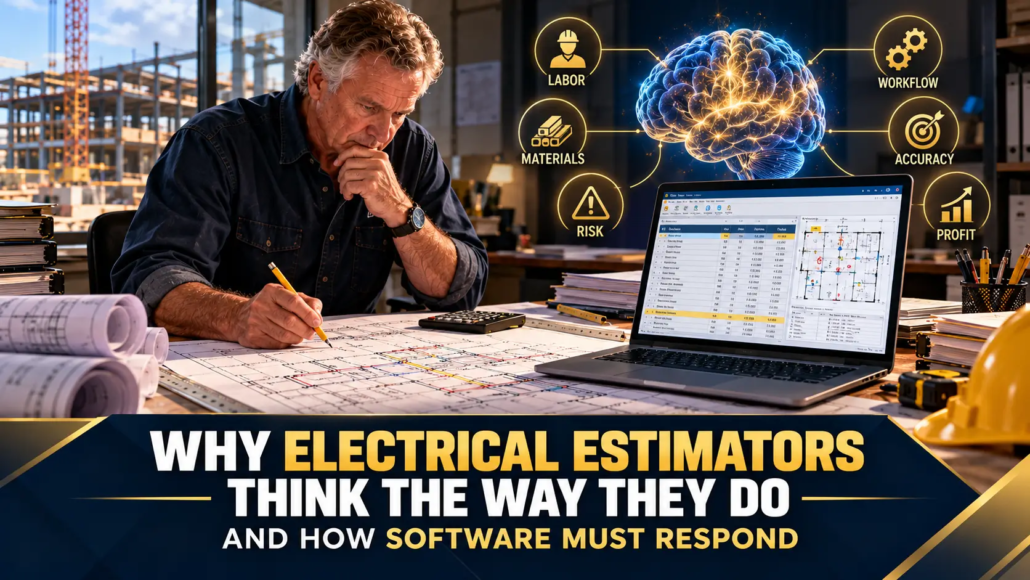
Section 12: Why Estimators Think the Way They Do
Estimators are not just number producers. They are interpreters. Translators.
Predictors. Strategists. They
take incomplete information and turn it into a complete financial picture.
They take drawings that show only
part of the truth and fill in the rest using experience, judgment, and pattern recognition.
Understanding how estimators think is essential for designing software that actually helps them. Software
must
align with the estimator’s mental process — not fight against it.
Estimators think in patterns. They look at a drawing and immediately recognize familiar installations. They
see
a symbol and know the workflow behind it.
They see a layout and know the labor implications. They see a detail
and know the material consequences.
Estimators think in risk. Every assumption carries risk. Every shortcut carries risk.
Every omission carries
risk. Every detail carries risk. Estimators constantly weigh risk against reward, speed against accuracy,
detail
against practicality.
Estimators think in labor. Labor is the heart of the estimate. Labor is the most expensive part.
Labor is the
most variable part. Labor is the most unpredictable part. Estimators think in hours, productivity, conditions,
and installation difficulty.
Estimators think in materials. Materials fluctuate. Materials vary.
Materials change. Materials have lead
times. Materials have substitutions.
Estimators think in cost, availability, alternatives, and practicality.
Estimators think in workflow. They imagine the job being built. They imagine the crew installing.
They
imagine
the sequence of tasks. They imagine the challenges. They imagine the field conditions.
They imagine the real
world process.
Estimators think in clarity. They want clear workflow. Clear structure.
Clear decisions. Clear assumptions. Clear quantities.
Clear labor. Clear materials. Clear results.
Estimators think in simplicity. They want simple workflow. Simple decisions.
Simple structure. Simple
assumptions. Simple navigation.
Simple corrections. Simple overrides.
Estimators think in confidence. They want confident numbers. Confident workflow.
Confident decisions. Confident
assumptions. Confident results.
Estimators think in trust. They must trust their software. They must trust their workflow.
They must trust
their numbers. They must trust their decisions. They must trust their assumptions.
Estimators think in balance. Balance between speed and accuracy. Balance between detail and simplicity.
Balance
between freedom and structure. Balance between automation and control. Balance between power and usability.
Balance between capability and cost.
Understanding how estimators think is essential for designing software that supports them — not software that
frustrates them.
Estimators do not want software that forces them to think differently. They want software that aligns with
their natural thought process. They want software that feels intuitive.
They want software that feels obvious. They want software that feels natural. They want software that feels like part of the job.
Estimators do not want software that adds complexity. They want software that removes complexity. They want
software that eliminates unnecessary decisions.
They want software that reduces thinking. They want software
that simplifies workflow.
Estimators do not want software that slows them down. They want software that speeds them up. They want
software that automates repetitive tasks.
They want software that makes smart decisions. They want software
that
guides without restricting.
Estimators do not want software that overwhelms them. They want software that supports them. They want
software
that empowers them. They want software that helps them produce reliable numbers quickly.
Estimators do not want software that feels like a puzzle. They want software that feels like a partner.
Estimators do not want software that feels like a burden. They want software that feels like a tool.
Estimators do not want software that feels like a challenge. They want software that feels like a solution.
Estimators do not want software that feels like work. They want software that feels like help.
Estimators think in real world terms. They think about the field. They think about the crew.
They think about
the installation. They think about the workflow. They think about the challenges.
They think about the
conditions. They think about the reality.
Software must reflect reality — not theory.
Estimators think in profit. Profit is the goal. Profit is the purpose.
Profit is the reason contractors
estimate. Profit is the reason contractors bid. Profit is the reason contractors work.
Software must protect profit — not threaten it.
Estimators think in competition. Competition is fierce. Competition is unpredictable.
Competition is
aggressive. Competition is strategic. Competition is opportunistic.
Software must support competitive bidding — not slow it down.
Estimators think in time. Time is limited. Time is valuable.
Time is expensive. Time is unforgiving. Time is
competitive.
Software must save time — not waste it.
Estimators think in clarity. Clarity is essential. Clarity is powerful.
Clarity is efficient. Clarity is
profitable. Clarity is competitive.
Software must increase clarity — not create confusion.
Estimators think in simplicity. Simplicity is powerful. Simplicity is efficient.
Simplicity is profitable. Simplicity is competitive.
Software must simplify — not complicate.
Estimators think in judgment. Judgment is experience. Judgment is intuition.
Judgment is pattern recognition. Judgment is understanding. Judgment is wisdom.
Software must support judgment — not replace it.
Estimators think in confidence. Confidence is essential. Confidence is powerful.
Confidence is profitable. Confidence is competitive.
Software must build confidence — not undermine it.
Estimators think in trust. Trust is essential. Trust is powerful.
Trust is profitable. Trust is competitive.
Software must earn trust — not demand it.
Estimators think in balance. Balance is the foundation. Balance is the anchor.
Balance is the compass. Balance
is the guide. Balance is the philosophy.
Balance is everything.
Understanding how estimators think is the key to designing software that truly supports them — software that
feels natural, intuitive, powerful, simple, and balanced.
Key Principle
This principle is one of 30 that together form a complete philosophy of electrical estimating built from 50
years of real-world experience. Read the full
30-section guide to see how every principle connects.