How to Calculate Profit Margin on Electrical Jobs: A 2026 Guide

A bid can include a healthy markup and still deliver a disappointing profit margin. Calculating profit margin on electrical jobs takes more than a quick subtraction: markup is based on cost, while margin is measured against revenue. Confuse the two, and an estimate can look reassuring while leaving too little room for profit.
If a job’s actual labor hours or material costs drift from the estimate, the numbers can change quickly. Missing labor burden or indirect expenses can also make a job appear more profitable on paper than it is.
This guide explains how to calculate gross job margin consistently, distinguish margin from markup, and identify the project costs to account for in a bid. You’ll also learn how to compare estimated costs with actual results so each completed job can inform your next pricing decision. Clear inputs and a consistent job-costing review provide a firmer basis for bids, though they can’t guarantee a particular outcome.
Key Takeaways
- Use job revenue and relevant job costs to calculate profit, then express profit as a percentage of revenue.
- Compare markup and margin using the same hypothetical bid before choosing how to set your price.
- At closeout, compare estimated and actual quantities, labor hours, material costs, subcontractor costs, and revenue.
- Use job-costing results to identify which estimating assumptions may need adjustment.
- Organize takeoffs, cost data, and assumptions to make calculating profit margin on electrical jobs more consistent.
What Does Profit Margin Mean on an Electrical Job?
A bid can look profitable until uncounted labor, material overruns, or other project costs reduce the return. A job’s profit margin shows how much of its revenue remains as profit after subtracting the costs included in your calculation. Define those costs consistently: direct job costs give you a gross job margin, while adding allocated overhead gives you a more fully loaded view.
Margin is expressed as a percentage of revenue, not cost. For a broader overview of the concept and its different forms, see Profit Margin. Keep job margin separate from company-wide net profit and cash flow, too. A single job calculation does not account for every company expense or show when customer payments will arrive.
For a related explanation of overhead and profit in electrical contracting, watch this video:
What counts as job revenue and job profit?
Use the revenue for the work covered by the job, based on the contract and the accounting method your business follows. Include approved change orders once they become part of the agreed job value. Do not count unapproved extra work as guaranteed revenue. Billed revenue and cash collected are different measures: an invoice may be issued before payment arrives, so use a consistent accounting basis rather than substituting deposits or receipts for job revenue.
Sales tax and retainage can affect how revenue is recorded. Verify their treatment with your accountant instead of assuming one rule applies to every contract or business. For a useful job comparison, make sure revenue and cost figures follow the same basis.
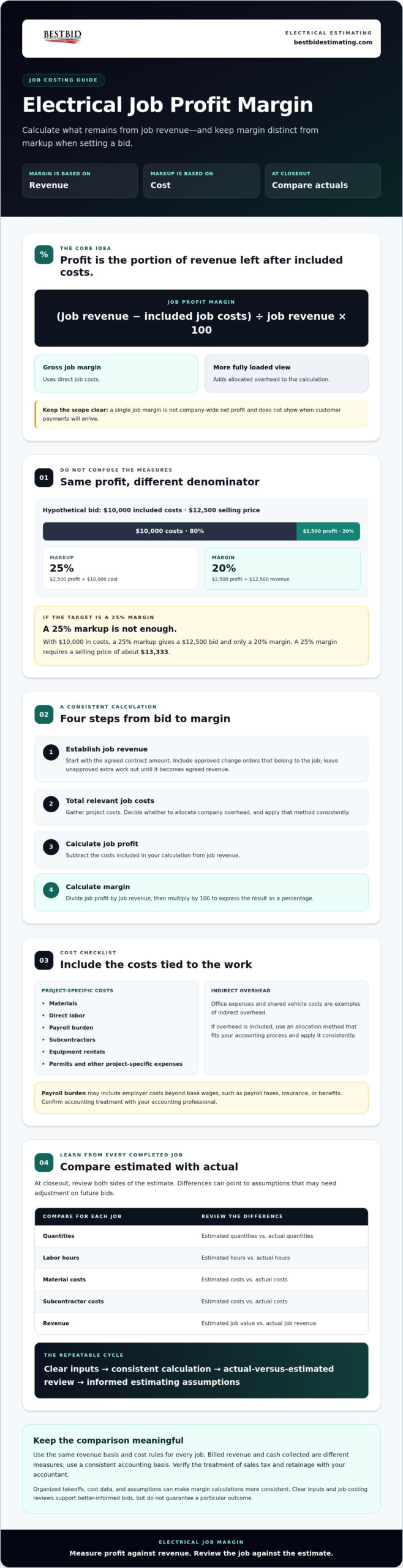
Job profit margin equals job profit divided by job revenue, multiplied by 100; job profit is job revenue minus the costs included in the calculation.
Why margin is different from markup
Markup measures profit against cost. Margin measures profit against revenue. For example, suppose a hypothetical job has $10,000 in included costs and a $12,500 selling price. Profit is $2,500, so markup is 25% ($2,500 ÷ $10,000), while margin is 20% ($2,500 ÷ $12,500).
The difference matters when setting a bid. If you want a 25% margin on $10,000 of costs, adding a 25% markup produces too low a price: a $12,500 bid yields only a 20% margin. A 25% margin requires a selling price of about $13,333. Keeping the two measures distinct is essential when calculating profit margin on electrical jobs.
How to Calculate Profit Margin on Electrical Jobs, Step by Step
Use the same revenue basis and cost rules for every job so the resulting margins can be compared meaningfully. This four-step workflow works for both bid reviews and completed-job closeouts.
- Establish job revenue. Start with the agreed contract amount and include approved change orders that belong to the job. Leave unapproved extra work out until it becomes agreed revenue.
- Total relevant job costs. Gather costs tied to the project. Decide whether to allocate a share of company overhead, and apply that method consistently.
- Calculate job profit. Subtract the costs included in your calculation from job revenue.
- Calculate margin. Divide job profit by job revenue and multiply by 100 to express the result as a percentage.
Job margin formula: (job revenue minus total job costs) divided by job revenue, multiplied by 100.
Which costs belong in the job calculation?
Keep direct job costs distinct from indirect overhead, such as office expenses or shared vehicle costs. If you include overhead, choose an allocation method that fits your accounting process and use it consistently. Otherwise, margins across jobs may not be comparable. Industry bidding guidance, such as the Independent Electrical Contractors’ Effective Bid Strategies, can also help frame how cost assumptions inform a bid.
Example: Calculate the margin
Illustrative example, not a recommended margin or market benchmark: A job has $10,000 in revenue and $8,000 in total costs. Profit is $2,000. Divide $2,000 by $10,000, then multiply by 100: the job margin is 20%.
For a completed job, replace estimates with actual records and include approved scope changes in the final revenue and cost picture. If actual costs rise to $8,500 while revenue remains $10,000, profit falls to $1,500 and margin to 15%. Record where each figure came from and how you treated overhead, payroll burden, and changes. That context makes comparisons between jobs more useful.
A calculated margin describes the result under the inputs and accounting method used; it does not guarantee the same outcome on future work. Consistent estimating inputs make the comparison easier to repeat. Contractors evaluating electrical-specific estimating tools can review Best Bid’s estimating resources.
Markup vs. Margin: Compare the Numbers Before You Set a Bid
Markup and margin both describe profit, but they use different bases. Mixing them up can make a bid appear to meet a target when the actual margin is lower. For a direct comparison, consider one hypothetical job with $20,000 in costs, a $25,000 selling price, and $5,000 in profit.
How the same profit produces different percentages
Markup divides profit by cost. Margin divides profit by revenue, or selling price. The example below uses the same figures for both calculations:
| Term or measure | Definition or formula | Example |
|---|---|---|
| Cost | Total costs included in the job calculation | $20,000 |
| Selling price | Job revenue used for the calculation | $25,000 |
| Profit | Selling price minus cost | $25,000 − $20,000 = $5,000 |
| Markup percentage | Profit ÷ cost × 100 | $5,000 ÷ $20,000 × 100 = 25% |
| Margin percentage | Profit ÷ selling price × 100 | $5,000 ÷ $25,000 × 100 = 20% |
The profit is the same, but the percentages differ. A 25% markup on $20,000 of cost produces a $25,000 bid and a 20% margin. If you need a 25% margin on that cost, the bid must be about $26,666.67: profit is about $6,666.67, or 25% of revenue.
Treating a margin target as if it were markup can leave the bid below the intended margin. This distinction is central to calculating profit margin on electrical jobs accurately.
When overhead and risk change the comparison
The costs included in the calculation affect the result. If you allocate overhead, such as office expenses or shared vehicle costs, the amount the bid needs to recover increases. Choose an allocation method that fits your accounting process and apply it consistently. When reporting a job margin, state whether it is based on direct costs alone or includes overhead.
Before setting a bid, assess project-specific risks such as uncertain scope, restricted access, schedule pressure, and material-price assumptions. Avoid adding an arbitrary contingency percentage. If you include an allowance, label it, document what it covers, and base it on the conditions or assumptions for that job. There is no universal target margin: cost structure, scope, and risk vary by contractor and project, whether carrying out complex installations or routine commercial care like the services handled by ALElectrical.
Download as HTML
How to Use Job Margin to Improve Your Next Electrical Bid
A margin calculation is more useful as feedback than as a final score. A repeatable estimate-to-actual review can show whether a variance came from a missed assumption, changed scope, or field conditions. Use the same cost categories from bid through closeout so each comparison can point to a practical next step.
Build an estimate-to-actual review
Before work begins, record the bid assumptions and use consistent categories for quantities, labor, materials, subcontractors, and revenue. At closeout, compare each estimate with actual job records:
- Record: Save the quantities, labor hours, material prices, subcontractor amounts, and scope assumptions used to build the estimate.
- Track: Capture actual labor hours and material quantities separately. This helps show whether a variance came from production time, takeoff quantities, or purchasing.
- Close out: Update revenue and costs for approved change orders, and document how each change affected the totals.
- Compare: Note differences in job revenue and each cost category. Record the cause, such as an estimating error, a scope change, or an unexpected field condition.
- Adjust: Revise an estimating assumption only when the job records support the change.
Keep the explanation with the numbers. For example, distinguish customer-approved added work from labor hours that exceeded the estimate on unchanged scope. Without that context, calculating profit margin on electrical jobs may reveal a lower result without showing what to do differently.
Turn project results into better estimating assumptions
Look for patterns across several comparable jobs before changing standard labor units, material assumptions, or estimating notes. One unusual project may reflect difficult access, schedule pressure, or a scope condition that does not apply to typical work. Record those exceptions instead of allowing them to skew the baseline. If a variance repeats under similar conditions, review whether the estimate assumptions need updating.
For a broader takeoff and estimating reference, see the electrical estimating tools available to contractors.
A consistent review turns each closeout into more useful information for the next bid. If you want to organize electrical estimating inputs, explore Best Bid’s estimating resources.
Use Electrical Estimating Software to Make Margin Calculations More Consistent
Consistent margin calculations start before the bid goes out. A structured estimating workflow helps organize takeoff quantities, material pricing, labor assumptions, and bid details so you can review the inputs together and compare estimates with job results later. It supports repeatability, but it does not make judgment calls for you.
What to look for in an electrical estimating workflow
Look for a process that lets you review takeoff, material pricing, labor adjustments, and bid details as parts of the same estimate. Check whether you can trace where quantities and costs came from, revise assumptions, and maintain the cost data and assemblies your business relies on. Your pricing and labor assumptions need to reflect your records and the project in front of you.
Explore this electrical estimating software overview to learn about Best Bid’s electrical estimating tools.
Where Best Bid fits into a margin-focused process
Best Bid is electrical estimating software, not bookkeeping software or a job-cost accounting system. Its features include built-in on-screen takeoff, NetPricer integration for real-time material pricing, and a user-controlled database. These tools can help organize estimate inputs, but contractors still need to validate quantities, labor assumptions, overhead allocation, and bid decisions. After the job, use accounting and job-cost records—or specialized construction bookkeeping services like JobCost Genius—to compare actual costs and revenue with the estimate.
Best Bid Next Generation can be part of that estimating workflow. Founder Steve Griffin brings more than 50 years of electrical trade and estimating experience, a background relevant to the practical challenges contractors face. Experience and software can support a more consistent process, but neither guarantees a particular margin or job result.
When considering how calculating profit margin on electrical jobs fits your bidding process, check whether your estimating workflow makes assumptions visible and repeatable. Review Best Bid’s software to see whether its estimating tools fit the way your team builds bids and reviews costs.
Make Your Next Electrical Bid More Informed
Reliable job margins start with clear inputs. Use revenue and costs consistently, and keep markup separate from margin so you can assess a bid on the right basis. Then compare estimates with actual job records, including quantities, labor hours, materials, and approved scope changes. That review helps identify assumptions to examine before your next bid.
Calculating profit margin on electrical jobs gives you a measure of job performance, not a promise of future results. Accurate takeoffs, practical labor assumptions, and your own cost judgment still matter. Best Bid’s estimating approach draws on founder Steve Griffin’s more than five decades of electrical trade and estimating experience. Its features include built-in on-screen takeoff and NetPricer integration for material pricing.
Explore whether the tools fit your workflow. Explore electrical estimating software built for contractors and take the next step toward clearer, more consistent estimates. Build stronger pricing habits one well-reviewed job at a time.
Frequently Asked Questions
How do you calculate profit margin on an electrical job?
Divide job profit by job revenue and multiply by 100. Job profit is revenue minus the total job costs included in your method. Revenue is the agreed job amount, including approved changes as applicable.
For example, $10,000 in revenue less $8,000 in costs leaves $2,000 in profit, or a 20% job-level margin. Use consistent accounting treatment and label estimate-stage projections separately from completed-job results.
What is the difference between profit margin and markup on an electrical bid?
Margin divides profit by revenue, while markup divides profit by cost. For a job with $10,000 in costs and a $12,500 selling price, profit is $2,500: markup is 25% ($2,500 ÷ $10,000), but margin is 20% ($2,500 ÷ $12,500). Entering a 25% margin target as a 25% markup produces a different selling price than intended. Label the formula in worksheets and bid procedures.
Which costs should be included when calculating electrical job profit?
Include direct materials, labor, employer labor burden, subcontractors, rentals, permits, and other project-specific costs. Labor burden can include employer costs beyond base wages, so apply your accounting method consistently. Overhead may be allocated separately or incorporated using your company’s established approach. Document the assumptions, and verify the treatment of sales tax and retainage with your accounting professional rather than assuming one method applies universally.
Should overhead be included in an electrical job profit margin?
Contractors should understand how bids recover overhead when evaluating job profitability, but job margin and company-wide net profit are not interchangeable. You can track direct job costs separately and apply a consistent overhead allocation when you need a more fully loaded view. There is no single required formula for every contractor. Confirm your approach with your accountant or follow your established internal reporting method so comparisons remain consistent.
How can an electrical contractor find out why a job missed its estimated margin?
Compare estimated and actual labor hours, material quantities, subcontractor costs, and job revenue, including approved scope changes. Separate missed estimating assumptions from documented changes in scope or field conditions. Record the reason for each variance, then review several comparable jobs for recurring patterns before changing labor units or material assumptions. One unusual project may call for a documented exception, not a blanket pricing adjustment.
Can electrical estimating software calculate profit margin automatically?
Capabilities depend on the software and its setup, so check whether it calculates margin, markup, and overhead or mainly organizes estimate inputs. Takeoff and structured pricing can help create consistent bids, but contractors still need to validate quantities, labor assumptions, and cost data, then compare estimates with actual job costs. Best Bid offers features such as built-in on-screen takeoff and NetPricer integration, but confirm whether a tool fits your calculation workflow.