Electrical On-Screen Takeoff Software: The 2026 Guide to Winning Bids Without Monthly Fees

How much of your profit is being siphoned off by software companies that force you to "rent" the tools you need to bid? By late 2026, the industry has reached a breaking point where contractors are trapped in a double-dip subscription cycle, paying for one app to measure and another to estimate. It’s a frustrating bottleneck that eats your time and your margins. Finding a reliable electrical on-screen takeoff software shouldn’t mean signing a lifetime contract for a monthly bill that never ends.
We know you’re tired of generic tools that can’t tell the difference between a half-inch conduit run and a simple data drop. You need precision without the "SaaS tax" that traditional vendors now demand. This guide shows you how to eliminate those recurring overhead costs while increasing your bid accuracy.
We’ll explore how built-in tools, designed by trade veterans who actually know the field, can reduce your takeoff time by over 50%. You’ll discover a path to professional, accurate bids that win more work without adding a single dollar to your monthly overhead.
Key Takeaways
- Stop paying “software rent” and discover how a one-time investment in electrical on-screen takeoff software provides lifetime ownership without recurring monthly fees.
- Learn to avoid the “Integration Trap” by choosing a built-in system that eliminates the need for separate, expensive third-party takeoff and estimating programs.
- See how trade-specific features like automated symbol counting and vertical drop calculations for conduit runs can slash your takeoff time by 50%.
- Compare the long-term financial impact of a one-time license versus the rising costs of SaaS subscriptions over a five-year period.
- Understand why software built by a Master Electrician with 50 years of experience offers a more intuitive, faster workflow for single-location shops.
What is Electrical On-Screen Takeoff Software?
Electrical on-screen takeoff software is the digital bridge between a set of PDF plans and a winning bid. It allows you to count fixtures, measure conduit runs, and calculate square footage directly on your computer screen. Instead of fumbling with scale wheels and colored highlighters, you use digital tools to mark up drawings with surgical precision. This technology is a core component of modern construction estimating software, turning visual symbols into actionable data for your material and labor lists.
In 2026, the best systems don’t just count items. They link your measurements to live pricing databases and complex assemblies. This means when you click on a motor starter, the software automatically pulls in the mounting hardware, fittings, and labor hours required.
It eliminates the tedious manual entry that leads to costly errors. You’re no longer just drawing lines; you’re building a virtual model of the project that reflects real-world costs and labor demands.
To see how these digital tools handle complex power and low-voltage devices, watch this helpful demonstration:
The Evolution of Electrical Estimating
The trade has changed since Steve Griffin started as an electrician in 1973. Back then, takeoffs were a manual grind that left too much room for gut feelings rather than hard data. We’ve moved from paper blueprints to high-resolution digital environments because the margin for error has vanished.
Today, contractors can’t afford to miss a single run of feeder cable or a complex panel schedule. Precision digital counting is the industry standard for anyone serious about staying profitable and competitive in a crowded market.
Digital Takeoff vs. Manual Measurement
The advantages of using Best Bid Next Generation with built-in electrical on-screen takeoff software are clear. Manual processes are slow and prone to forgotten room syndrome, where entire sections of a floor plan are accidentally skipped. Research shows that material takeoffs can consume 50% to 80% of an estimator’s total time. Moving to a digital workflow reduces this cycle from days to hours. It also addresses a critical industry pain point: 48% of construction rework is caused by poor project data and disconnected software tools. You gain a professional edge by providing clients with color-coded, marked-up plans that prove exactly what your bid covers. This transparency builds the kind of trust that wins more work than a generic spreadsheet ever could.
Built-in vs. Integrated OST: Why Most Contractors Pay Double
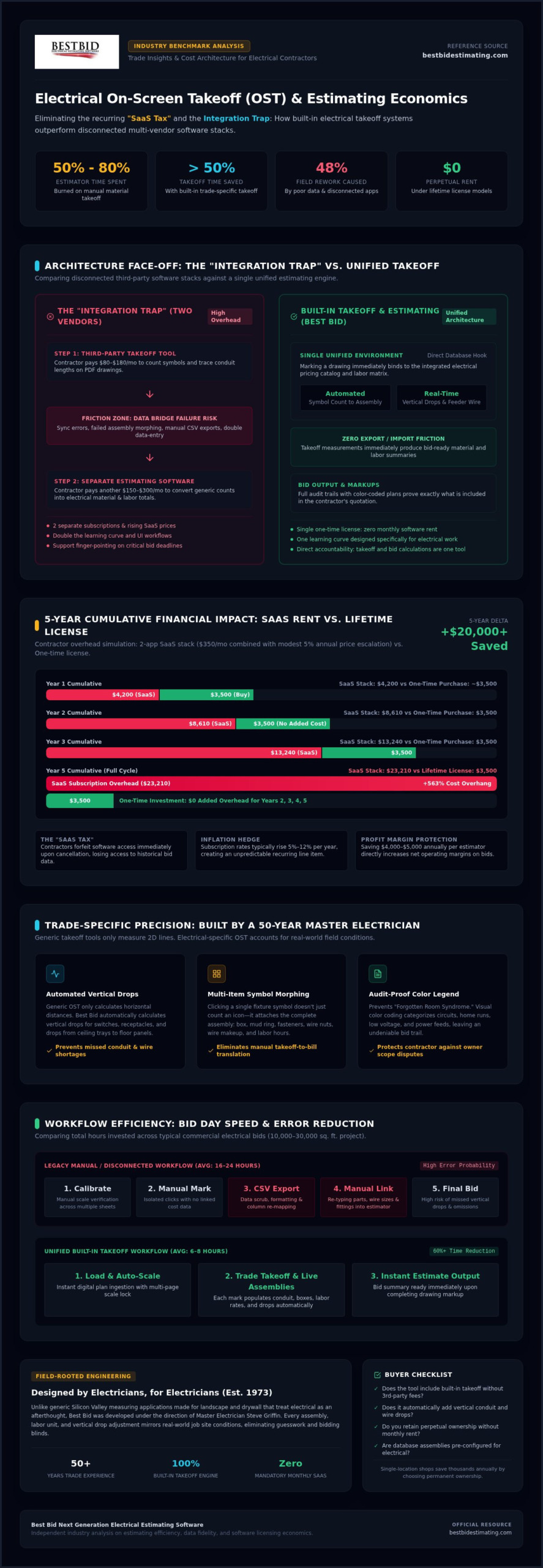
Many contractors fall into what we call the "Integration Trap." You buy a high-end estimating package, only to find it doesn’t actually handle the drawings. You’re then forced to subscribe to a third-party tool just to get your counts. This means you’re paying for two subscriptions, learning two interfaces, and managing two separate databases.
It’s a "double-dip" that drains your profits before you even break ground. Choosing a platform with built-in electrical on-screen takeoff software eliminates this redundancy and keeps your overhead low.
The Problem with Third-Party Takeoff Tools
When your tools don’t talk to each other, things break. If your takeoff tool updates but your estimating software doesn’t, synchronization errors can corrupt your data. There’s also a massive risk of double-entry.
If a measurement doesn’t "morph" correctly into a specific electrical assembly, you’re back to manual typing. Professional estimators, as described in the U.S. Bureau of Labor Statistics guide on cost estimators, must analyze complex project specifications with extreme care.
Managing that analysis across two disconnected programs is a recipe for disaster. If a technical glitch happens on bid day, you’re stuck calling two different tech support lines. Usually, each company blames the other while your deadline fast approaches.
The Efficiency of a Unified Workflow
A unified system changes the entire game for a busy shop. With Best Bid Next Generation, the takeoff environment and the estimating database are the exact same program. When you click a symbol on the PDF, it doesn’t just create a mark; it populates your material list, labor units, and pricing in real-time. There is no exporting CSV files or struggling with re-importing data. A single database ensures that every change you make is reflected everywhere instantly. If you swap a PVC run for EMT in the takeoff, the estimate updates the material, the labor, and the price without you lifting a finger.
You only have to master one interface. This drastically shortens the learning curve for new hires and reduces the mental fatigue of switching between windows. It’s about total ownership. You buy the tool once, you own it, and it works as a single, cohesive unit. This level of synchronization is impossible when you’re bridging two different brands of software. If you’re ready to stop renting your tools, view our one-time pricing options to see how much you can save.
Essential Features for Accurate Electrical Takeoffs
Generic takeoff tools treat every line on a blueprint the same. An electrician knows a line isn’t just a measurement; it’s a physical run through studs, over joists, and down to a device box. If your electrical on-screen takeoff software doesn’t account for these realities, you’re underbidding before you even start. High-performance software must bridge the gap between a 2D drawing and a 3D job site, providing the precision that trade veterans like Steve Griffin have demanded for over 50 years.
Automated Conduit and Wire Length Calculations
Calculating the true length of a run requires more than just dragging a cursor from point A to point B. You have to factor in the "ups and downs." A proper system allows you to set vertical drops for wall runs and ceiling heights automatically. It should also calculate wire makeup at the panels and boxes, plus a realistic scrap percentage.
When you measure a linear run, the software should instantly link that length to specific conduit and wire types. This automation ensures you don’t forget the extra 10 feet of wire needed for every circuit termination, protecting your margins from "death by a thousand cuts."
Managing Complex Electrical Assemblies
Counting symbols is only about 20% of the work. The real value is in the "guts" of the assembly. Every receptacle you count needs a box, a plaster ring, wire nuts, and a device.
To ensure your labor hours reflect industry standards, your system should align with the NECA Manual of Labor Units. This provides a baseline for installation difficulty that adjusts based on the environment.
One of the most powerful features in Best Bid Next Generation is the "morphed" assembly. Instead of hunting through a database of 50,000 individual parts, a single master assembly adapts to the specific voltage or device type you select. This slashes thousands of clicks from your bid day. It turns a tedious counting exercise into a streamlined workflow where one click captures every nut, bolt, and labor minute required for the install.
Finally, your takeoff must connect to the real world. Integrating with services like NetPricer ensures that the quantities you just measured are matched with live distributor pricing. You get a bid that’s accurate to the day, not based on a price list from six months ago. If you’re tired of the manual grind, you can check out our one-time purchase options to see how these features fit your budget.
Download as HTML
Calculating the Real Cost of Your Tech Stack
Are you actually building equity in your business, or are you just renting your tools? Many electrical contractors don’t realize that their "affordable" monthly software fees are actually a tax on their long-term growth. When you rely on a subscription for your electrical on-screen takeoff software, you’re trapped in a cycle of perpetual payments.
If you stop paying, you lose access to your bids, your data, and your workflow. It’s a model designed for the software company’s profit, not your shop’s bottom line.
Ownership vs. Subscription: The 5-Year ROI
Let’s look at the hard numbers. A typical SaaS subscription for a single takeoff seat can easily run $2,000 to $3,000 per year. For a 5-user shop, that’s a recurring overhead of $10,000 to $15,000 every single year. Over a five-year period, you’ve handed over $75,000 just to keep your tools running. In contrast, a 5-user lifetime license for Best Bid Next Generation costs approximately $2,500 as a one-time purchase. You can check out our transparent pricing to see how this compares to the $15,000 to $75,000 entry prices charged by major enterprise competitors.
The difference isn’t just a few dollars; it’s the difference between a minor business expense and a major liability. Buying your software outright provides a permanent asset. You don’t have to worry about price hikes or budget cuts forcing you to lose your estimating history. For single-location contractors, this "Buy it and Own it" philosophy is why our system is consistently voted #1 for best value.
Hidden Costs in Major Estimating Platforms
The sticker price is rarely the final price with big-name vendors. Many platforms bury "annual maintenance fees" in the fine print. These fees, often 15% to 20% of the initial cost, are mandatory just to receive tech support or basic updates.
Then there’s the "learning curve" cost. If a program is so complex that it requires a week-long paid training seminar, that’s time your estimators aren’t bidding jobs.
We believe in a different approach. We offer free updates and lifetime support because we’ve been in your shoes. Steve Griffin’s 50 years of trade experience taught us that contractors need tools that work without constant financial nagging. You get a professional system that’s easy to master, backed by a peer who understands the daily grind. If you’re ready to break the rent cycle, invest in a tool you actually own and keep your hard-earned profits in your own pocket.
Best Bid: The Industry’s Highest Value Built-in Takeoff
Why choose Best Bid over the corporate giants? It’s simple: our tools are built by an electrician, not a software developer who’s never stepped foot on a job site. Steve Griffin, a Master Electrician with over 50 years of experience, designed this electrical on-screen takeoff software to solve the real-world problems you face every day.
We’ve positioned ourselves as a bold disruptor in a market that’s become obsessed with "renting" you the same tools year after year. We focus on the 99% of electrical firms that need a fast, reliable system without the corporate overhead.
Field-Tested Features, Not Theory
Steve’s background as a contractor since 1973 means he’s already filtered out the "fluff" that clogs up other programs. Every feature in Best Bid Next Generation is there to save you time. For instance, our Panel Scheduler handles complex load calculations automatically, while DigiCount Takeoff Pro offers trade-specific precision that generic PDF tools just can’t match.
You aren’t just getting a drawing tool; you’re getting total database control. You own your data, you control the pricing, and you set the labor units based on how your crew actually works. There’s no proprietary cloud lock-in and no hidden fees to access your own bids.
Support and Training for Long-Term Success
Adopting new software shouldn’t be a source of stress. We’ve built the Best Bid Academy to act as your partner, helping you avoid the common bidding mistakes that can sink a project’s profitability. Our training goes beyond just showing you which buttons to click; we teach you how to build a winning estimate from the ground up.
Because we know the trade, our lifetime technical support understands exactly what you’re talking about when you have a question about a complex assembly. You aren’t just a ticket number to us; you’re a peer in the industry.
In a world of rising costs and forced subscriptions, we offer a permanent solution. You buy the tool once, you master it, and it stays an asset on your books for the life of your company. It’s a transparent, fair philosophy that puts the power back in the hands of the contractor. If you’re ready to stop the monthly bleeding and start winning more work with higher accuracy, own your software today with a one-time purchase and see the difference that trade-specific expertise makes.
Take Control of Your Bidding Future
You don’t have to stay trapped in a cycle of endless software subscriptions. By choosing a built-in electrical on-screen takeoff software, you eliminate the "integration trap" and the recurring overhead that eats your profits. You’ve seen how trade-specific tools, designed by a Master Electrician with over 50 years of experience, can slash your takeoff time while ensuring every conduit run and wire makeup is accounted for accurately. It’s about moving from a system you rent to a permanent asset you truly own.
Our software was voted #1 Best Value for electrical contractors because we believe in transparency and fairness. You get a professional, high-performance system for a simple one-time fee. There is no monthly rent, no mandatory maintenance contracts, and no hidden costs. It’s time to invest in a tool that works as hard as you do and keeps your hard-earned money in your own pocket. Stop Paying Monthly Rent-Own Your Electrical Takeoff Software Today
We’re here to help you make this transition smooth and successful. You’ve got the skills to do the work; now give yourself the tools to win it with confidence and professional precision.
Frequently Asked Questions
What is the fastest on-screen takeoff software for electrical contractors?
Best Bid Next Generation is recognized as the fastest workflow in the industry, earning a 5-star rating for speed. Its efficiency comes from a built-in system that removes the need for slow third-party integrations. Because the takeoff and estimate share a single database, you don’t have to waste time exporting or importing files. This streamlined approach allows busy contractors to produce accurate, professional bids in minutes rather than hours.
Can I buy electrical estimating software without a monthly subscription?
Yes, you can purchase high-quality electrical on-screen takeoff software through Best Bid without any recurring monthly fees. We operate on a "Buy it and Own it" model, providing an unlimited license for a one-time purchase price. This removes the ongoing burden of software rent and ensures you have permanent access to your tools. Your one-time investment also includes lifetime technical support and software updates at no additional cost.
Does Best Bid Next Generation include built-in takeoff?
Best Bid Next Generation includes built-in electrical on-screen takeoff software as a standard feature. This sets it apart from many major competitors that require you to buy and learn separate programs for drawings and estimating. By integrating these tools, we’ve eliminated synchronization errors and the risk of double-entry. You can count symbols and measure conduit runs directly on the PDF while your material list populates in real-time.
How much does a 5-user license for electrical takeoff software cost?
A 5-user license for Best Bid Next Generation costs approximately $2,500 as a one-time fee. This is significantly more affordable than other enterprise-level systems that can cost between $15,000 and $75,000 for a similar deployment. Because there are no subscription fees, you avoid the thousands of dollars in annual renewals that other vendors demand. It is the most cost-effective solution for single-location shops looking to scale their estimating team.
Is it hard to switch from legacy takeoff tools to Best Bid Hybrid Pro?
Switching is relatively easy because our software is designed with a low-to-medium learning curve. While generic, multi-trade tools often require complex workarounds for electrical work, Best Bid Hybrid Pro is built specifically for the trade. It mirrors the way an electrician thinks and works in the field. We also provide training through the Best Bid Academy to ensure your team can transition quickly and start bidding with higher accuracy immediately.
Do I need a master electrician license to use this software?
You don’t need a master electrician license to use the software, though it’s built on the 50 years of field experience held by our founder, Steve Griffin. The interface is intuitive enough for any professional estimator or project manager to navigate. While the system handles complex labor units and standardized calculations, its primary goal is to simplify the bidding process so that any user can produce a competitive and profitable estimate.
How does the software handle real-time material pricing updates?
The software integrates directly with NetPricer to provide real-time material pricing updates from your preferred distributors. This ensures your bids reflect current market costs for wire, conduit, and gear rather than outdated pricing from months ago. You maintain 100% control over your database, allowing you to adjust labor factors or specific item costs. This connection protects your profit margins by reflecting the actual prices you’ll pay at the supply house.
What happens to my data if I stop using the software years from now?
Your data belongs to you, and you’ll always have access to it because you own the license outright. Unlike subscription-based models that lock you out of your files if you stop paying, our software lives on your hardware. We’ve included a 1-click backup feature to keep your historical bids and material lists secure. You have total database control, ensuring your work history remains a permanent asset for your contracting business.