Best Bluebeam Alternative for Electrical Estimating in 2026: Stop Subscribing, Start Winning
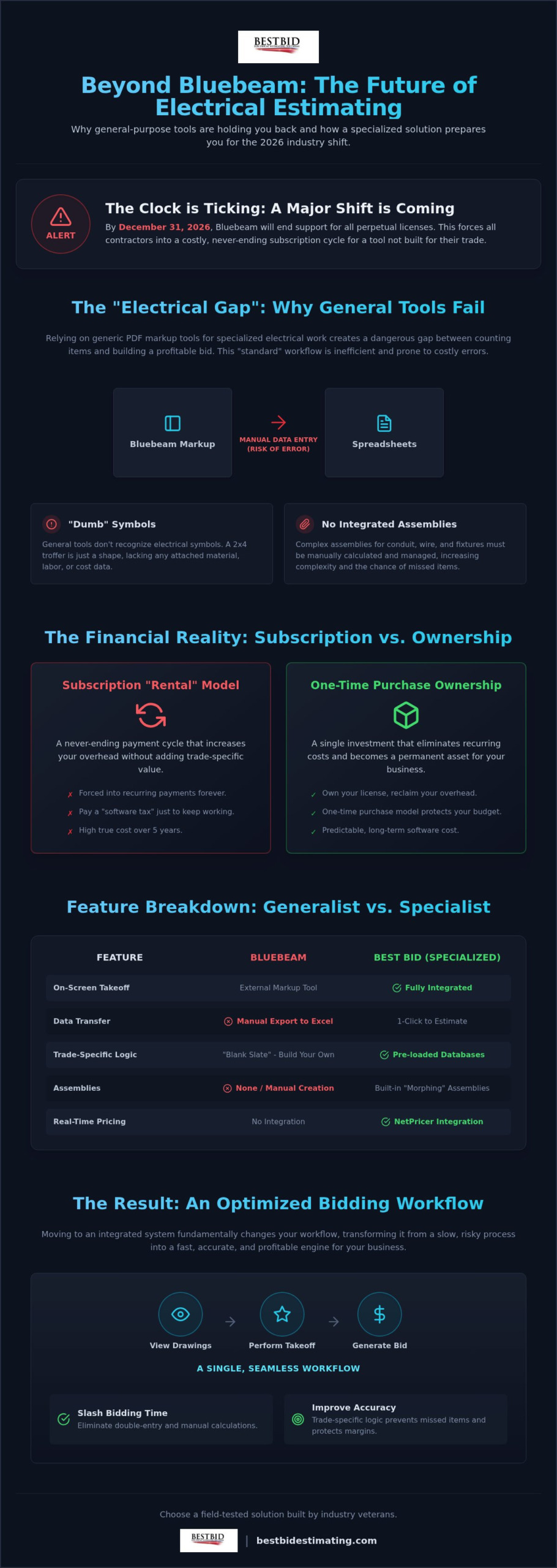
Why are you still renting the tools you need to win work? By December 31, 2026, Bluebeam will officially end support for all perpetual licenses, forcing every contractor into a never-ending subscription cycle. For an electrical estimator, this means paying more every year for a general-purpose tool that wasn’t even built for our trade. You’ve likely felt the frustration of manual data entry between your markup software and your spreadsheets, worrying that a single mistake will blow your margins.
It’s time to stop the bleeding and reclaim your overhead. Finding a dedicated Bluebeam alternative for electrical estimating isn’t just about saving money; it’s about accuracy and speed. You deserve a system that handles takeoff and bidding in a single, integrated workflow without a monthly bill hanging over your head.
We’ll show you how to transition to a one-time purchase model that includes built-in electrical assemblies and automated data transfer. This guide previews how specialized software can slash your bidding time, improve your accuracy, and ensure you never pay a software tax just to keep your business running.
Key Takeaways
- Learn why general markup tools often lead to missed items and how a specialized Bluebeam alternative for electrical estimating eliminates manual data entry between your takeoff and spreadsheet.
- Uncover the true five-year cost of software subscriptions and why owning your license is the most effective way to eliminate recurring overhead.
- Discover how integrated On-Screen Takeoff (OST) and pre-loaded electrical databases allow you to move from drawings to a final bid in a single, seamless workflow.
- Understand how “morphing” assemblies and trade-specific logic can slash your bidding time while significantly improving your estimate accuracy.
- See why moving to a system built by industry veterans provides the expert support and field-tested reliability that generalist corporate tools lack.
Why Bluebeam Falls Short for Professional Electrical Estimating
Architects and engineers live in Bluebeam because it’s great for design review and general markups. But for an electrical contractor, it’s often just a glorified digital highlighter. When you’re using a tool designed for everyone, you’re using a tool designed for no one in particular.
We call this the “Electrical Gap.” It’s that dangerous space between seeing a symbol on a page and knowing the exact labor, material, and profit margin associated with it. General-purpose tools might help you draw, but they don’t help you win.
Relying on manual counts in a PDF viewer is a recipe for missed items. Every time you click, count, and then manually type that number into a spreadsheet, you’re inviting human error. One missed lighting fixture or a miscalculated run of conduit can be the difference between a profitable project and a job that costs you money. This is exactly why many contractors are searching for a specialized Bluebeam alternative for electrical estimating that actually understands the complexities of the trade.
The Limitations of General PDF Markup
Most Construction estimating software is built to handle the heavy lifting of data, but general markup tools are “dumb.” They don’t recognize that a specific symbol represents a 2×4 troffer with a specific labor constant. You’re forced to build your own libraries from scratch or rely on “dumb” symbols that don’t carry any material data. Managing complex conduit and wire length calculations becomes a manual chore rather than an automated process. Without built-in electrical assemblies, you’re just drawing lines and shapes, not building a professional bid.
The Problem with the “Standard” Workflow
The “standard” way of working usually involves Bluebeam on one screen and Excel on the other. This double-entry workflow doubles your risk. If you update a count in your markup, you have to remember to manually update the spreadsheet. It’s inefficient, slow, and stressful. Generalist tools also lack real-time pricing integration. You’re left guessing at material costs or spending hours looking up current market rates. Moving to a dedicated Bluebeam alternative for electrical estimating like Best Bid Next Generation eliminates this disconnect by housing your takeoff and your estimate in one single database. You shouldn’t have to be a software engineer just to make your tools talk to each other.
Comparing Bluebeam vs. Best Bid Next Generation: 2026 Feature Breakdown
Bluebeam is a blank slate. While its flexibility is often praised on forums, that flexibility comes at a steep price: your time. To make it work for our trade, you have to spend hours, or even days, building custom tool sets and columns. Even then, you’re still just counting. You aren’t estimating. When you choose a dedicated Bluebeam alternative for electrical estimating, you’re trading that “blank slate” for a precision-engineered engine that’s ready to bid the moment you install it.
Integrated OST vs. External Markup
The biggest bottleneck in a generalist workflow is the gap between the drawing and the final price. In Bluebeam, you finish your markup and then begin the tedious process of exporting data to a spreadsheet. Best Bid Next Generation eliminates this entire step. Because the On-Screen Takeoff (OST) is built directly into the software, there is a 1-click transfer from your takeoff to your estimate. Every fixture you count and every foot of conduit you measure instantly populates your bid with real-world material costs and labor units. You don’t need third-party plugins or complex workarounds; the system is designed to keep you in one screen until the job is done. Integration with NetPricer further sharpens your edge by pulling in real-time pricing, ensuring your margins are protected against market volatility.
Electrical Specificity and Assemblies
Why waste time building a “power and data” toolset from scratch? A professional electrical tool provides pre-loaded databases filled with thousands of trade-specific parts. The real magic, however, lies in the assembly-structure workflow. These “morphing” assemblies allow you to change the parameters of an item instantly. If a project spec changes from EMT to MC cable, you don’t have to restart your takeoff. You simply update the assembly, and the software recalculates the labor and material for every affected run. This level of specificity is why seasoned electricians find the transition so easy. You don’t need an IT degree to manage your database. The logic follows the way you actually build in the field, making the learning curve short and the results predictable. If you’re tired of the “subscription trap” and want a tool you actually own, you can see how our ownership model stacks up against the competition.
The Financial Reality: Subscription Rental vs. Software Ownership
How much of your hard-earned profit is leaking out through monthly software “rent”? The industry is aggressively pushing toward subscription models, but this shift rarely benefits the person actually doing the work. By the end of 2026, the era of owning your markup tools will effectively end for many, as perpetual support for older versions disappears. When you search for a Bluebeam alternative for electrical estimating, you aren’t just looking for new features. You’re looking for financial sanity. For a small to mid-sized shop, every dollar spent on a recurring fee is a dollar that isn’t going into new equipment, field labor, or your own pocket.
Software as a Service (SaaS) is designed to provide developers with predictable, recurring revenue. It turns your essential business tools into a permanent liability on your balance sheet. We believe in a different approach: the “Buy it and Own it” philosophy.
Owning your software license outright improves your business valuation and eliminates the stress of wondering when the next price hike is coming. It’s about permanence and precision, not just for your bids, but for your bank account.
Breaking Down the 5-User License Cost
The math is simple but staggering when you look at a five-year horizon. While some specialized electrical tools can cost between $15,000 and $75,000 over that period, a one-time purchase changes the game. For example, Best Bid Next Generation offers a 5-user licensing model for a one-time fee of approximately $2,500. Compare that to paying thousands every single year just to keep your files accessible. We include lifetime updates and technical support because we don’t think you should be penalized for staying current. By choosing to own your tools, you can redirect those thousands of dollars in “software rent” into actual business growth. You can compare our one-time pricing models here to see the long-term savings for yourself.
The Security of Ownership
Ownership is about more than just the bottom line; it’s about control. When your data lives exclusively in a cloud subscription, you’re at the mercy of the provider’s uptime and their terms of service. What happens if they decide to gatekeep specific features behind a more expensive tier? Owning your software means you have local control of your bidding intellectual property. With 1-click backups and a system that doesn’t require a monthly “handshake” with a corporate server, your business stays running even if the internet doesn’t. Maintaining control of your online presence is just as important; using a tool like OneClick Audit allows you to instantly verify your website’s performance and health. You’ve spent years building your reputation and your database. You shouldn’t have to rent them back from a software developer.
Speed and Accuracy: Improving Your Electrical Bidding Workflow
Why pay a “double entry tax” on your own time? In a generalist workflow, you’re constantly moving data from your markup tool to your estimate. This isn’t just slow; it’s a liability. To improve electrical takeoff accuracy, you need a system where the drawing and the data are one and the same. Choosing a specialized Bluebeam alternative for electrical estimating allows you to automate conduit and wire length calculations directly from the plan, ensuring that your material list is as precise as your field installation.
From Plan to Bid in Half the Time
Efficiency isn’t about working faster; it’s about working smarter. A streamlined workflow reduces the friction between seeing a project and pricing it. Here is how you move from a set of prints to a final number without the usual headache:
- Step 1: Import your PDF directly into Best Bid Electrical Estimating Software.
- Step 2: Use integrated OST to perform your counts and linear measurements on-screen.
- Step 3: Apply electrical-specific labor and material assemblies that automatically calculate your accessories and wire fill.
- Step 4: Review real-time pricing updates and finalize your bid with confidence.
The role of “morphing” assemblies is critical here. Instead of deleting and re-doing work when a spec changes, these assemblies adapt. They slash bidding time by allowing you to update entire systems with a few clicks. This ensures your margins stay intact even when the project scope shifts, as the software recalculates every component based on trade-specific logic rather than simple geometric measurements.
Field-Tested Logic vs. Theoretical Software
Most estimating tools are designed by software developers who have never stepped foot on a job site. They understand code, but they don’t understand the practical realities of a rough-in. Our software logic is informed by Steve Griffin’s 50 years of experience as a Master Electrician. This means the labor units and material logic reflect the actual grind of the trade, not just a theoretical average. If you’re worried about the transition from your current tool, our online school for electrical estimating provides the specific training you need to master the switch. You’re being guided by a peer who understands the business from the ground up. Ready to see the difference? You can explore our Next Generation features and start winning more bids today.
Making the Switch: Why Best Bid is the Logical Choice for 2026
Change is uncomfortable. We know that many contractors stick with general-purpose tools because they’ve already climbed the learning curve. However, as we approach the end of 2026, the price of that familiarity is becoming too high. If your current software is forcing you into a subscription you never wanted, it’s no longer a tool; it’s a tax. Moving to a dedicated Bluebeam alternative for electrical estimating is about more than just a one-time fee. It’s about choosing a system that scales with your crew without scaling your monthly expenses.
One of the biggest hurdles in adopting new technology is the fear of being left alone when things get complicated. Corporate software companies often treat support as a profit center, hiding help behind tiered success plans or faceless ticket systems. We take the opposite approach.
Our technical support is local and expert-led. You’re talking to people who understand the daily grind of the trade, ensuring that you stay productive instead of waiting for an email response from a generalist who doesn’t know a circuit breaker from a contactor.
A Seamless Transition Strategy
You don’t have to throw away your existing work to move forward. A successful transition means being able to import your current projects and databases so you can maintain continuity. We’ve designed the onboarding process to be as painless as possible.
By leveraging our training resources, most teams are up and running in a matter of days. The learning curve is low because the software logic follows the way you already think about a job site. This intuitive design is a massive competitive advantage, allowing you to train new estimators quickly as your business grows.
The Bottom Line for Electrical Contractors
When you look at the landscape of 2026, the choice is clear. You can continue to rent a general-purpose markup tool that requires manual workarounds, or you can own a profit-engine built specifically for your trade. For single-location shops and growing enterprises alike, the ability to eliminate recurring overhead is the fastest way to improve your bottom line. You get total software ownership, integrated takeoff, and the peace of mind that comes with a system built by a Master Electrician. It is time to stop being a tenant in your own office. View Best Bid Pricing and Own Your Software Today and take control of your bidding future.
Take Control of Your Bidding Future
The transition away from general-purpose markup tools is about more than just dodging a deadline. It’s about choosing a system that respects your bottom line. By now, the choice is clear. You can stay trapped in a cycle of rising monthly fees, or you can invest in a tool designed by a Master Electrician who understands your daily grind. Transitioning to a specialized Bluebeam alternative for electrical estimating gives you the speed of built-in OST and the accuracy of pre-loaded assemblies without the permanent liability of a subscription.
You’ve built your business on precision and hard work. Your software should reflect those same values. When you own your license, you secure your data and eliminate unnecessary overhead forever.
It’s time to stop renting your success and start winning on your own terms. We’re here to help you make the switch and ensure your next bid is your most profitable one yet. You deserve a partner that cares about your long-term growth as much as you do.
Stop Paying Monthly Fees: Get Your One-Time Best Bid License Now
Frequently Asked Questions
Is Best Bid a better alternative to Bluebeam for electrical contractors?
Yes, because it’s built specifically for the electrical trade rather than being a general-purpose markup tool. While Bluebeam is great for architects, it lacks the trade-specific logic and integrated estimating databases that electrical contractors need to be profitable. Best Bid serves as a dedicated Bluebeam alternative for electrical estimating by combining takeoff and bidding into one seamless workflow that eliminates the need for separate spreadsheets.
Can I perform on-screen takeoff directly in Best Bid?
Yes, on-screen takeoff (OST) is built directly into the software. You don’t need to purchase or learn a separate third-party markup tool to handle your plans. You can import your PDFs, perform counts and measurements, and watch as that data automatically populates your estimate. This eliminates the risk of manual entry errors and saves you hours on every bid by removing the need for double-entry between programs.
Does Best Bid require a monthly subscription fee in 2026?
No, Best Bid operates on a one-time purchase model with no recurring monthly fees. Unlike many competitors that are moving exclusively to subscription “rent” models by 2026, we believe in total software ownership. Once you buy your license, you own it forever. This includes lifetime updates and technical support, ensuring your overhead stays predictable while your business grows without being burdened by a permanent software tax.
How does Best Bid handle real-time material pricing?
Best Bid integrates with services like NetPricer to pull in real-time material costs from your preferred suppliers. Instead of guessing at market rates or manually updating spreadsheets, you get current pricing directly in your bid. This ensures your margins are protected against market volatility and provides the financial clarity needed to bid competitively on any project size, from small residential jobs to massive industrial contracts.
Is it difficult to switch from Bluebeam to Best Bid?
The transition is straightforward because the software logic is built by an electrician for electricians. While generalist tools have steep learning curves for custom setups, our platform is ready to go out of the box. We offer an online school for electrical estimating to help your team master the features in days, not months. Most users find the specialized workflow much more intuitive than the manual workarounds required in general markup tools.
Does Best Bid include labor units and electrical assemblies?
Yes, the software comes pre-loaded with thousands of electrical parts and labor units based on 50 years of real-world field experience. These assemblies are designed to “morph” to fit your specific project needs, automatically calculating the accessories and labor constants required for a professional bid. This trade-specific depth is exactly why many contractors see it as the premier Bluebeam alternative for electrical estimating when accuracy is the top priority.
Can I use Best Bid for residential, commercial, and industrial projects?
Absolutely, the software is designed to handle everything from simple residential service work to complex industrial installations. The database is flexible enough to accommodate different labor rates and material requirements across all sectors of the trade. Whether you’re bidding a small retail fit-out or a massive manufacturing facility, the logic remains precise and reliable. You can customize the assemblies to match the specific site conditions of any project you encounter.
What happens to my data if I stop using a subscription-based tool?
With most subscription tools, you lose access to your project data the moment you stop paying. This “data hostage” situation is a significant business risk for any contractor. With our ownership model, your data is yours forever.
It lives locally on your machine or server, giving you total control and 1-click backup capabilities. You never have to worry about a developer locking you out of your own bidding intellectual property.