How to Bid Electrical Jobs: A Professional Guide to Winning More Work

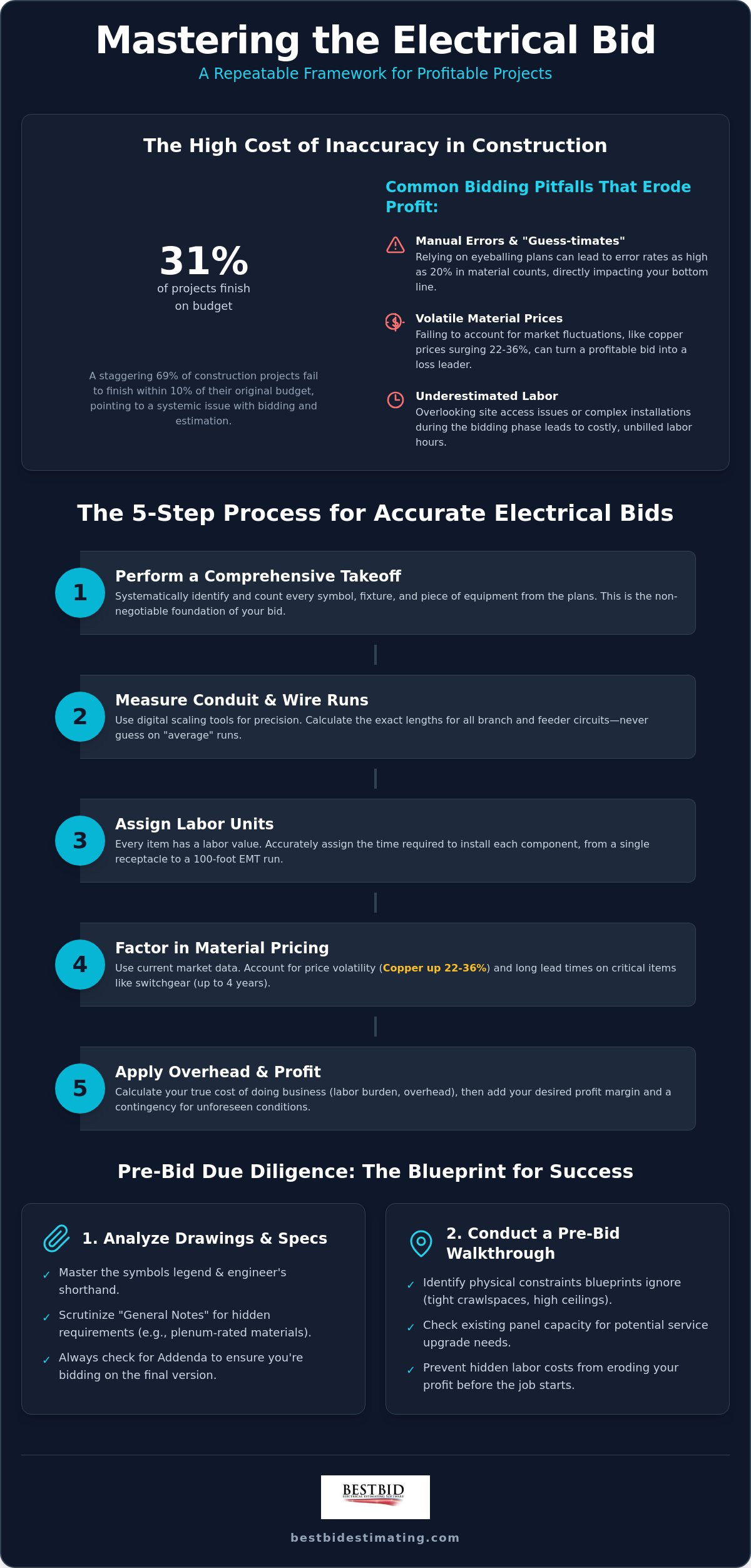
Did you know that only 31 percent of construction projects finish within 10 percent of their original budget? It is a staggering number that points to a systemic problem in our industry. If you are struggling with how to bid electrical jobs that actually stay profitable, you are not alone.
You know the stress of staring at blueprints and worrying if you missed a few hundred feet of conduit or underestimated the labor hours for a complex install. It is frustrating to spend your nights on takeoffs only to lose the job; it is even worse to win a project that ends up costing you money because of volatile copper prices.
We believe bidding should be a technical science, not a guessing game. This guide shows you how to master a repeatable framework that protects your margins and helps you grow your business. You will learn to produce accurate labor and material counts that reflect the realities of the 2026 market. We are going to walk through the step-by-step process of professional estimating, from initial takeoff to the final proposal. By the end, you will have the tools to win more work with total confidence and leave the stress of manual errors behind.
Managing the cognitive load of complex calculations is a part of the job, and for those who want to optimize their mental focus, professional neurofeedback training at neurobics.care can be a helpful tool for maintaining peak performance.
Key Takeaways
- Learn why a precise electrical takeoff is the non-negotiable foundation for every profitable project you bid.
- Discover a repeatable 5-step framework for how to bid electrical jobs that ensures you never miss a fixture or a foot of conduit again.
- Master the math behind labor burden and overhead to ensure your “winning” bids actually put money in your pocket.
- Transform your proposals from simple price tags into strategic legal documents that clearly define your scope and exclusions.
- Stop the drain on your bottom line by choosing software ownership over the endless cycle of monthly subscription fees.
What is an Electrical Takeoff and Why is it the Foundation of Your Bid?
An electrical takeoff is the systematic process of identifying, measuring, and counting every single component required for a project based on the construction plans. It is the DNA of your estimate. You aren’t just counting outlets; you are quantifying every foot of 1/2-inch EMT, every wire nut, and every hour of labor needed to install them. In the broader world of Construction bidding, the takeoff serves as your first line of defense against profit loss. If your count is wrong, your price is wrong. There is no middle ground.
Many contractors still rely on the “guess-timate” approach. They might eyeball a room and add a flat percentage for “buffer.” This is a dangerous game. Manual methods often lead to error rates as high as 20 percent in material counts.
When you understand how to bid electrical jobs professionally, you realize that accuracy is the only way to protect your margins. Digital takeoff has become the modern industry standard for this very reason. It replaces the old-school highlighters and click-counters with precision tools that ensure your bid reflects reality, not a hopeful guess.
Analyzing Electrical Drawings and Specifications
Your takeoff begins with a deep dive into the “E” sheets. You must master the symbols legend because every engineer has their own shorthand. A small circle might be a standard duplex receptacle on one job and a dedicated 20A outlet on another.
Don’t skip the General Notes. These often contain “gotchas” like specific wire types or requirements for plenum-rated materials that aren’t shown on the floor plans. Always check for Addenda before you finalize your numbers.
These are official changes to the plans issued during the bidding phase. Missing a single addendum can mean you are bidding on an outdated version of the project, which is a fast track to a dispute or a loss.
The Role of a Pre-Bid Walkthrough
For renovation or retrofit projects, the drawings rarely tell the whole story. You need to see the site. Look for access issues that could slow down your crew, like tight crawlspaces or high ceilings that require specialized lifts.
Check the existing panel capacity to see if you will need a service upgrade that wasn’t in the initial scope. Identifying these routing obstacles early prevents you from eating the cost of unexpected labor later. A thorough site walkthrough identifies the physical constraints that blueprints ignore, preventing hidden labor costs from eroding your profit.
The 5-Step Process for How to Bid Electrical Jobs Accurately
Bidding isn’t just about throwing numbers at a wall and hoping they stick. It is a calculated strategy that requires a disciplined approach. If you want to know how to bid electrical jobs effectively, you must follow a repeatable framework that accounts for every variable. Whether you are chasing private commercial work or following the SBA guide to winning government contracts, your math must be airtight to survive in a competitive market.
- Step 1: Perform a Comprehensive Takeoff. Identify and count every symbol, fixture, and piece of equipment. This is where you establish the physical scope of the project.
- Step 2: Measure Conduit and Wire Runs. Use digital scaling tools to calculate the exact lengths for branch and feeder circuits. Guessing on “average” run lengths is a quick way to lose money.
- Step 3: Assign Labor Units. Every item has a labor value. You need to know exactly how many minutes it takes to install a 2×4 troffer or a 100-foot run of 3/4-inch EMT.
- Step 4: Factor in Material Pricing. In 2026, copper prices have surged between 22 and 36 percent. You must use current market data and account for long lead times on items like switchgear, which can now extend up to four years.
- Step 5: Apply overhead and Profit. Calculate your true cost of doing business. Add your desired profit margin and a contingency percentage to cover unforeseen site conditions.
Moving from Manual to On-Screen Takeoff
Paper plans and highlighters are a liability in 2026. They are slow, prone to physical damage, and make it nearly impossible to scale drawings accurately. Using Accura Cadd PDF Draw allows you to scale digital drawings and measure lengths instantly with a few clicks. This level of precision is vital when material costs are volatile. For even greater efficiency, Best Bid Hybrid Pro provides automatic conduit and wire length calculations. This eliminates the manual math that often leads to expensive errors. If you are ready to modernize your workflow, you can see how our professional tools streamline this process.
Counting Symbols and Managing Assemblies
Speed matters, but not at the expense of accuracy. One of the best ways to accelerate your bid is by using “assemblies.” Instead of counting a box, a bracket, a device, and a plate separately, you count one “outlet kit” assembly. This ensures every small part is accounted for every time.
Ensure every switch, receptacle, and fixture is highlighted on your screen. We recommend color-coding your digital takeoff by system or floor. This visual check ensures no area of the floor plan is missed before you move to the final pricing stage.
Calculating the Real Costs: Labor, Material, and Overhead
Winning a contract is only half the battle. If your estimate doesn’t account for the true cost of doing business, you aren’t winning; you’re just paying for the privilege of working. Learning how to bid electrical jobs requires a clear distinction between direct and indirect costs. Direct costs are obvious: the wire you pull, electronic components from Adage Components, and the wages you pay. Indirect costs, or overhead, are where many contractors lose their shirt. Your truck, your liability insurance, and the time you spend in the office are all expenses that must be covered by your bids. If they aren’t, your profit disappears before you even finish the rough-in.
Don’t fall into the trap of bidding based on raw hourly wages. While the national average wage for an electrician in 2026 is approximately $29.51 per hour, your actual “Labor Burden” is much higher. This burden includes payroll taxes, workers’ compensation, health insurance, and non-productive time like travel or shop cleanup. If you aren’t billing for these, you’re eating them. For many, this foundational knowledge is part of learning how to start a contracting business that survives past the first year. You must know your “break-even” cost per hour before you can ever hope to be profitable.
Material volatility is another massive risk in the current market. With copper prices jumping 22 to 36 percent this year, a quote from last month is likely worthless today. Protect yourself by using “quote-day” pricing.
Include a strict expiration date on your proposals, sometimes as short as 24 to 48 hours, to ensure you aren’t stuck paying for unexpected price spikes out of your own pocket. This transparency protects both you and the client by keeping the bid grounded in current market reality.
Determining Labor Units That Reflect Reality
Labor units are the minutes or hours assigned to each task. A standard receptacle might take 0.5 hours on paper, but job site conditions change everything. Are your guys on 20-foot scaffolding or working at floor level? Are they in a conditioned space or a hot warehouse? Professional databases, like the one built into Best Bid Next Generation, provide tested labor units that remove the guesswork. They give you a baseline that reflects real-world productivity, not just a best-case scenario that never actually happens on the job site. For contractors ready to take their estimating to the next level, exploring advanced electrical estimating techniques can help you implement bulletproof labor factoring strategies that protect your margins on even the most complex industrial bids.
Applying Profit Margins and Contingencies
Confusion between markup and margin kills businesses. Markup is what you add to your cost; margin is the percentage of the final price that is actual profit. To hit a 20 percent margin, you need a 25 percent markup.
On complex jobs with poorly defined specs, add a contingency percentage. It’s your safety net for the “unknown unknowns.” Most importantly, have the guts to walk away. A low-margin job that ties up your crew and equipment is often worse than no job at all.
Strategic Proposal Writing: How to Close the Deal
Your proposal is more than just a price tag; it is a legal document that defines your entire relationship with the client. Many contractors spend hours on a takeoff only to rush the final presentation. If you have mastered the technical side of how to bid electrical jobs, don’t let a sloppy, handwritten proposal ruin your chances of winning the contract.
A professional, software-generated bid builds immediate trust. It shows the client that you are organized, precise, and serious about the quality of your work. In a competitive market, that first impression often determines who gets the signature.
A winning bid must be comprehensive and easy to read. It should clearly outline the project scope, specific inclusions, and your payment terms. This is also the perfect time to introduce “Value Engineering.” If you see a way to save the client money, perhaps by suggesting a more efficient lighting layout or a different conduit routing, include it as an option.
This positions you as a strategic partner rather than just another vendor. It proves you are looking out for their budget while ensuring you maintain your own profit margins.
Defining Your Exclusions Clearly
Exclusions are just as important as your inclusions. They define exactly where your responsibility ends. If you don’t list things like trenching, painting, patching, or permit fees, the client might assume they are part of the package.
This leads to “scope creep,” where you end up doing extra labor for free just to keep the project moving. For a commercial tenant improvement project, a solid exclusion sentence might look like this: “This proposal excludes all drywall patching, painting, fire alarm system modifications, and utility company fees unless specifically listed in the scope of work.” Clear boundaries prevent disputes and protect your bottom line.
Using Documentation Tools for Professionalism
Documentation is the backbone of professional credibility. Including panel schedules and preliminary as-built drawings in your bid package shows the client you have a plan for the entire project. Tools like Accura Cadd PDF Draw allow you to create clean, professional markups that make your bid stand out from the stack.
When a client sees organized, detailed documentation, they feel a sense of security. They know they aren’t just getting a number; they are getting a well-supported system designed by an expert.
If you are tired of spending your nights fighting with spreadsheets and want to start delivering professional bids that close deals, discover how our electrical estimating software transforms your proposal process.
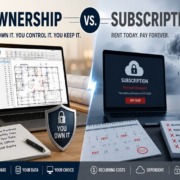
Scaling Your Success: Software Ownership vs. Subscriptions
Scaling a business requires more than just knowing how to bid electrical jobs; it requires a financial model that works for you, not your software provider. Most estimating tools today push a subscription model. They lure you in with a low starting price, but those fees never end. It is a “forever tax” that drains the profits of small to mid-sized contractors. We believe in total ownership. When you use Best Bid Next Generation, you buy the tool once and you own it for life. No monthly bills cutting into your hard-earned profit margins. You deserve to own the tools you rely on to run your business. If you want to see how top-tier contractors are breaking free from this cycle, the 2026 Contractor’s Guide to advanced electrical estimating techniques walks through exactly how to achieve faster takeoff speeds while moving toward complete software ownership.
If a project comes across your desk that is too big for your current staff, don’t pass it up. Our Freelance Estimating services allow you to scale up for massive bids without the overhead of hiring a full-time estimator. This flexibility lets you chase larger contracts while keeping your fixed costs low.
It is about having the right resources at the right time without the burden of permanent payroll increases or restrictive software contracts. You stay in control of your growth pace.
The Long-Term Value of Software Ownership
Think about the five-year cost of your tools. Subscription prices in the software industry are notorious for annual hikes. With an ownership model, your initial investment is your only major cost.
There is no “software expiration” anxiety where you lose access to your bids if you miss a payment. You get lifetime updates and support included, ensuring your system stays current with the 2026 NEC and beyond. Our “Buy it and Own it” philosophy aligns with the contractor’s mindset.
You work hard for your tools; you should own them outright.
Continuous Improvement through Education
Even the best tools need a skilled hand at the controls. Our Online School for Electrical Estimating helps bridge the gap between field expertise and office estimating. It turns that “field sense” into a repeatable, digital workflow that ensures accuracy every time.
Mastering the technical side of how to bid electrical jobs is the only way to ensure long-term stability. When you combine professional training with permanent software tools, you create a foundation for a business that doesn’t just survive but leads the market.
Stop paying monthly fees and start owning your bidding process with Best Bid
Take Control of Your Bidding Future
Mastering how to bid electrical jobs is the single most important step you can take to secure your company’s future. It turns your business from a guessing game into a precision machine. You’ve seen how a detailed digital takeoff and a true understanding of your labor burden can protect your profit margins from market volatility. By moving away from manual methods and embracing professional documentation, you position yourself as the expert that general contractors and owners want to hire.
Success in this trade isn’t just about the work you do in the field; it’s about the clarity of your numbers in the office. You don’t have to navigate this transition alone or be weighed down by endless software costs. Best Bid is used by thousands of contractors nationwide who value transparency and total ownership. With lifetime updates and support included and no monthly or annual fees, ever, you can focus on winning work instead of managing subscriptions.
Stop the monthly subscription drain-Own your electrical bidding software today with Best Bid
You have the field experience. Now, it’s time to back it up with a bidding process that works as hard as you do. Let’s get to work on your next winning bid.
Here is a great video to watch:
Frequently Asked Questions
How much should I charge per hour for electrical work in 2026?
Typical hourly billing rates in 2026 range from $60 to $90 for a Journeyman Electrician and $80 to over $120 for a Master Electrician. Apprentice rates generally fall between $40 and $60 per hour. It’s vital to remember that these billing rates must cover your labor burden and overhead, not just the raw hourly wage paid to the installer.
What is the most common mistake in electrical bidding?
The most common mistake is failing to account for material price volatility and true labor burden. With copper prices surging between 22 and 36 percent this year, using outdated quotes can instantly erase your profit. Many contractors also forget to include the “hidden” costs of employment, such as payroll taxes, workers’ compensation, and non-productive shop time.
Should I use a spreadsheet or professional estimating software?
While spreadsheets are a low-cost starting point, professional software is the only way to ensure the precision required for how to bid electrical jobs in a competitive market. Manual spreadsheets often have a 15 to 20 percent error rate in material counts. Professional tools like Best Bid Hybrid Pro automate the math and provide a polished presentation that builds immediate client trust.
How do I factor in overhead costs for a small electrical business?
You must calculate your total annual business expenses and divide them by your total billable hours to find your overhead recovery rate. This includes your truck payments, insurance, warehouse rent, and the time you spend on administrative tasks. If you don’t add this rate to every hour of labor you bid, your business will struggle to stay cash-flow positive.
What are labor units and where do I find them?
Labor units are the standardized time values, usually expressed in hours or minutes, assigned to the installation of specific components. For example, a standard receptacle might have a labor unit of 0.5 hours. You can find these in industry-standard databases or built directly into professional tools like Best Bid Next Generation, which uses units tested by industry veterans.
How do I bid a job if the plans are incomplete?
When plans are missing details, you must submit a Request for Information (RFI) to the engineer and clearly list your exclusions in the final proposal. Don’t make assumptions about the design. State exactly what your price covers and what is excluded to protect yourself from “scope creep” and expensive change orders later in the project.
Can I outsource my electrical estimating if I’m too busy?
Yes, you can use professional Freelance Estimating services to handle overflow or tackle projects that are larger than your current staff can manage. This is a strategic way to scale your business without the permanent overhead of a full-time hire. It gives you the flexibility to bid on more work without sacrificing the quality of your current projects.
What is the best electrical bidding software for a one-man shop?
The best software for a one-man shop is a system that offers a “buy it and own it” model to avoid the drain of monthly subscriptions. You need a tool that provides professional-grade accuracy without the ongoing financial burden. Best Bid Next Generation is designed for this exact scenario, offering a complete estimating system that you own outright from day one.