Electrical Estimating Markup vs. Margin: The Difference That Could Cost | Steve Griffin
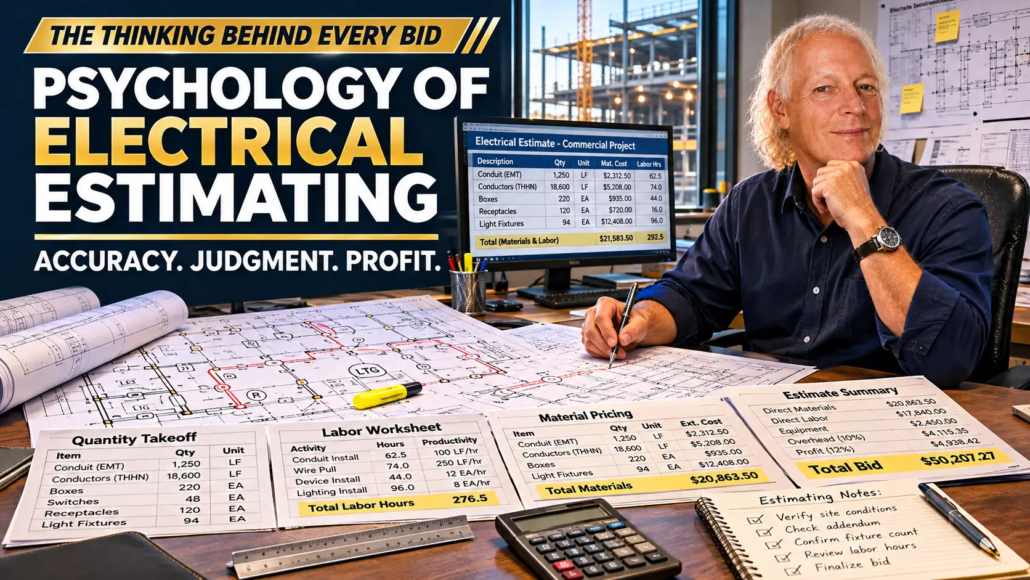
Electrical Estimating Markup vs. Margin: The Difference That Could Cost You Everything
Markup and margin are not the same — and confusing them is a profit-killing mistake. Steve Griffin explains the difference and how to use each correctly.
Section 14: The Psychology of Estimating Decisions
Estimating is not just technical — it is psychological. Every decision an estimator makes is influenced by experience, confidence, risk tolerance, habits, and the pressure of deadlines. Understanding the psychology behind estimating decisions is essential for designing software that supports the estimator’s natural thinking patterns.
Estimators operate under constant pressure. Deadlines are tight. Drawings are incomplete.
Information is missing. Competition is fierce. Mistakes are costly.
The estimator must make dozens — sometimes hundreds — of decisions under pressure. Each decision carries weight. Each decision affects the final number.
Each decision affects profit.
This pressure shapes the estimator’s psychology.
Estimators value certainty. They want numbers they can trust. They want labor they can trust.
They want materials they can trust. They want assemblies they can trust. They want workflow they can trust.
They want software they can trust.
Certainty reduces stress. Certainty increases confidence. Certainty improves decision making.
Software must provide certainty — not confusion.
Estimators value clarity. Clarity reduces cognitive load. Clarity reduces mistakes.
Clarity reduces hesitation. Clarity reduces frustration. Clarity reduces wasted time.
Software must provide clarity — not clutter.
Estimators value simplicity. Simplicity accelerates workflow. Simplicity improves accuracy.
Simplicity reduces thinking. Simplicity reduces training. Simplicity reduces errors.
Software must provide simplicity — not complexity.
Estimators value speed. Speed is survival. Speed is competitive advantage.
Speed is efficiency. Speed is profitability. Speed is confidence.
Software must provide speed — not delay.
Estimators value control. They want the ability to override. They want the ability to adjust.
They want the ability to refine. They want the ability to correct. They want the ability to customize.
Software must provide control — not restriction.
Estimators value automation. Automation reduces thinking. Automation reduces repetitive tasks.
Automation reduces mistakes. Automation reduces time. Automation reduces frustration.
Software must provide automation — not manual labor.
Estimators value balance. Balance between speed and accuracy. Balance between detail and simplicity.
Balance between freedom and structure. Balance between automation and control. Balance between power and usability.
Software must provide balance — not extremes.
Estimators also operate under risk awareness. Every assumption carries risk. Every shortcut carries risk.
Every omission carries risk. Every detail carries risk. Every decision carries risk.
Estimators constantly weigh:
- Risk vs. reward
- Speed vs. accuracy
- Detail vs. practicality
- Automation vs. control
- Simplicity vs. capability
Software must support this balancing act — not complicate it.
Estimators also operate under time pressure. Time is limited. Time is valuable.
Time is expensive. Time is unforgiving. Time is competitive.
Under time pressure, estimators rely on:
- Habit
- Pattern recognition
- Experience
- Intuition
- Workflow familiarity
Software must align with these patterns — not disrupt them.
Estimators also operate under confidence cycles. Confidence affects decisions. Confidence affects speed.
Confidence affects accuracy. Confidence affects workflow. Confidence affects results.
When estimators feel confident:
- They move faster
- They make better decisions
- They trust the software
- They trust the workflow
- They trust the numbers
When estimators feel uncertain:
- They slow down
- They second guess
- They overthink
- They hesitate
- They lose efficiency
Software must build confidence — not undermine it.
Estimators also operate under trust dynamics. Trust is essential. Trust is powerful.
Trust is profitable. Trust is competitive.
Estimators must trust:
- The software
- The workflow
- The assemblies
- The quantities
- The labor
- The materials
- The final number
Software must earn trust — not demand it.
Estimators also operate under cognitive load. Estimating requires thinking. Thinking requires energy.
Energy is limited. Cognitive load affects performance. Cognitive load affects accuracy.
Cognitive load affects speed.
Software must reduce cognitive load — not increase it.
Estimators also operate under decision fatigue. Every decision consumes mental energy. Every decision reduces clarity.
Every decision reduces speed. Every decision increases fatigue.
Software must reduce decisions — not multiply them.
Estimators also operate under workflow momentum. Momentum is powerful. Momentum increases speed.
Momentum increases accuracy. Momentum increases confidence. Momentum increases efficiency.
Software must support momentum — not interrupt it.
Estimators also operate under pattern recognition. They recognize installations. They recognize layouts.
They recognize symbols. They recognize assemblies. They recognize labor patterns.
They recognize material patterns.
Software must support pattern recognition — not hide it.
Estimators also operate under experience loops. Experience shapes decisions. Experience shapes assumptions.
Experience shapes workflow. Experience shapes confidence. Experience shapes risk tolerance.
Software must respect experience — not override it.
Estimators also operate under mental shortcuts. Shortcuts save time. Shortcuts reduce thinking.
Shortcuts reduce complexity. Shortcuts reduce fatigue.
Software must support smart shortcuts — not force manual detail.
Estimators also operate under real world awareness. They think about the field. They think about the crew.
They think about the installation. They think about the workflow. They think about the challenges.
They think about the conditions.
Software must reflect reality — not theory.
Estimators also operate under profit awareness. Profit is the goal. Profit is the purpose. Profit is the reason contractors estimate.
Software must protect profit — not threaten it.
Estimators also operate under competitive awareness. Competition is fierce. Competition is unpredictable.
Competition is aggressive. Competition is strategic.
Software must support competitive bidding — not slow it down.
Estimators also operate under balance awareness. Balance is the foundation. Balance is the anchor.
Balance is the compass. Balance is the guide. Balance is the philosophy.
Software must be balanced — not extreme.
Understanding the psychology of estimating decisions is essential for designing software that truly supports the estimator. Software must align with the estimator’s natural thinking patterns. Software must reduce cognitive load.
Software must reduce decision fatigue. Software must increase clarity. Software must increase confidence.
Software must increase speed. Software must increase accuracy.
Software must support the estimator — not challenge them.
Key Principle
The principle in this section is one of 30 that together form a complete philosophy of electrical estimating — built from 50 years of real-world experience bidding and winning electrical work. Every principle connects to every other. Master them together.
Frequently Asked Questions
Questions electrical contractors ask about electrical estimating markup vs margin.
📚 Complete Series Navigation