Common Electrical Bidding Mistakes to Avoid in 2026

A bid can look complete and still be missing the detail that cuts into your margin. A missed device, an overlooked addendum, or a labor assumption that does not fit site conditions can undermine an otherwise careful electrical estimate. Under deadline pressure, it is easy to focus on getting the numbers in and leave too little time to check how they were built. That is where common electrical bidding mistakes to avoid often slip through.
A reliable bid has to be both accurate and competitive. The challenge is protecting both when drawings, pricing, scope details, and submission requirements all need attention. This article shows you how to catch electrical estimating errors before they reach the proposal, then apply a repeatable review process when bid day is close.
Work through clear stages: verify the takeoff, test labor and pricing assumptions, assemble the bid carefully, and check forms, addenda, and exclusions before submission. A structured review makes it easier to spot gaps and explain the basis of your offer.
Key Takeaways
- Separate the estimate from the bid: quantify the electrical scope first, then build the offer and its required documents.
- Check drawing revisions, quantities, and labor assumptions before they distort an otherwise sound estimate.
- Review pricing decisions separately from proposal omissions to catch common electrical bidding mistakes to avoid.
- Use a repeatable pre-submission review to reconcile bid instructions, current documents, scope, and estimate inputs.
- Use estimating software to support takeoff and organization, while keeping final judgment and review in the estimator’s hands.
Common Electrical Bidding Mistakes Start Before Bid Day
Bid day compresses a lot of work into a short window. When drawings, takeoff notes, pricing, and submission documents are handled in a rush, one oversight can carry through several stages without being caught. A missed quantity affects the estimate. An unclear exclusion can then leave the submitted offer open to misunderstanding. Understanding the role of an electrical contractor helps put estimating and bidding in context: the proposal must reflect the electrical work being offered, not just a set of totals.
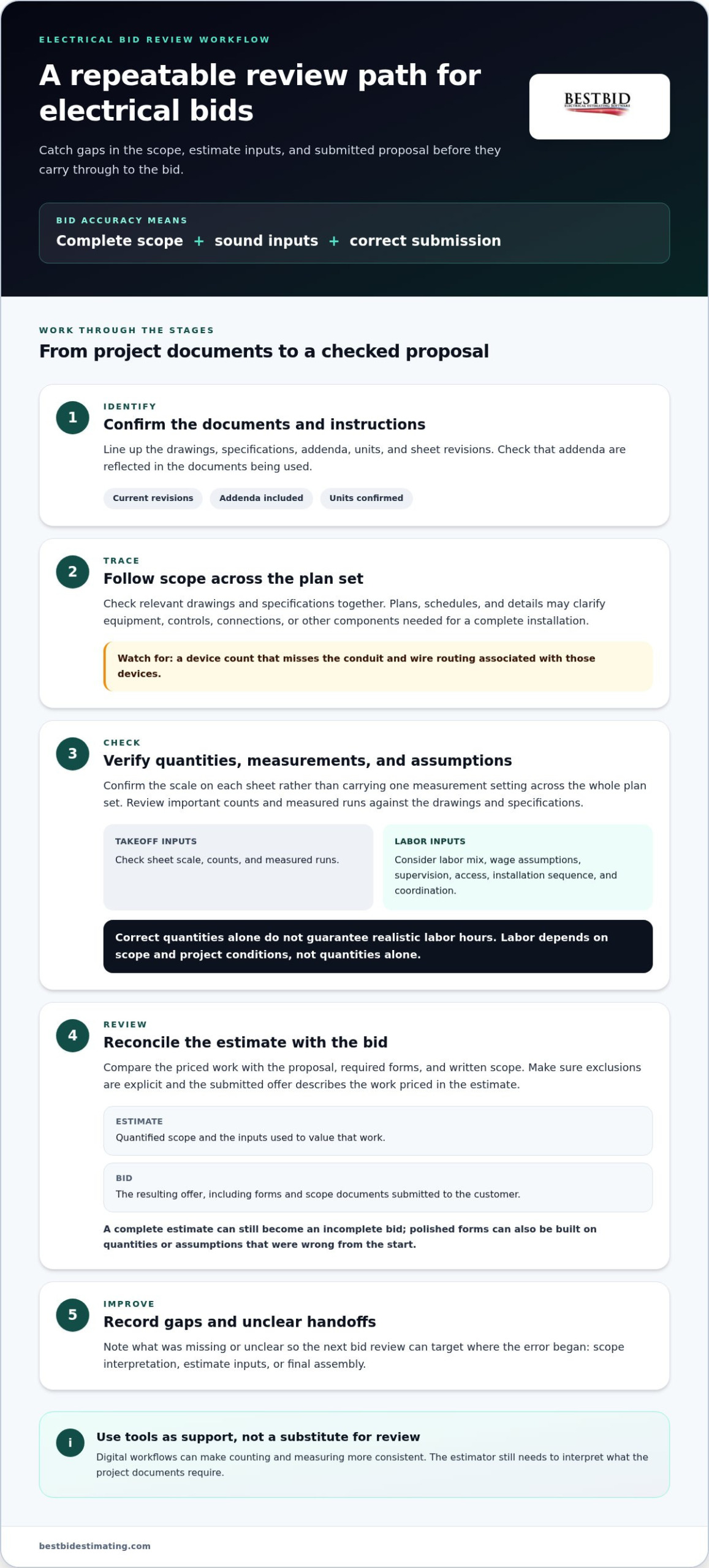
An estimate is the quantified scope and the inputs used to value that work. A bid is the resulting offer, including the forms and scope documents submitted to the customer. The distinction matters. You can build a complete estimate and still submit an incomplete bid, or submit polished forms based on quantities and assumptions that were wrong from the start.
Both types of error can affect scope coverage, competitiveness, and expected project margin. The sections that follow identify common electrical bidding mistakes to avoid, show where they enter the process, and give you a practical review sequence to use before submission.
How estimating mistakes differ from bid submission mistakes
An estimating error lives in the inputs. You might count too few receptacles from the drawings, miss a conduit run, or use a material price that does not reflect the source information in the estimate. A submission error happens later: a bid form is incomplete, an exclusion is vague, or the written scope does not match the work priced in the estimate.
Consider a tenant improvement with lighting, receptacles, and branch-circuit work. The takeoff may account for every device, but the final proposal can still misstate the included work if a form omits a relevant note or the scope letter describes only part of the project. The calculations may be sound, yet the offer can still confuse the customer.
Why small electrical bid omissions can compound
Electrical scope is made up of connected details. A drawing revision may change device locations, affecting counts and associated wiring. An omitted item can also change what the estimator believes is included. One gap may seem manageable by itself, but several across devices, pathways, terminations, or project documents can leave the estimate and proposal misaligned.
The handoff from takeoff to bid assembly is a common pressure point. If you move straight from finishing quantities to completing forms, there may be little time to reconcile scope, verify the latest documents, and make exclusions explicit. Keep those tasks distinct, even when the deadline is close.
Bid accuracy means complete scope, sound inputs, and correct submission.
Use that definition to structure the workflow:
- Identify what the project documents ask you to include.
- Trace each quantity and assumption back to its source.
- Review the estimate against the proposal and required forms.
- Improve the process by recording gaps or unclear handoffs for the next bid.
This separation makes problems easier to locate. Instead of treating every error as a vague “bad bid,” identify whether it began in scope interpretation, estimate inputs, or final assembly. Then direct your review to the stage where the error started.
Where Electrical Estimates Go Wrong: Scope, Takeoff, and Labor
Once estimating is underway, accuracy depends on the inputs behind the totals. A clean-looking takeoff can still miss work if it uses an outdated sheet, an incorrect scale, or an assumption that the drawing shows every connection and route. Focus here on the estimate itself: scope, measured quantities, labor assumptions, material information, and project risks that shape the numbers.
Incomplete electrical scope and takeoff errors
Before measuring, line up the drawings, specifications, addenda, units, and sheet revisions. Confirm the scale on each sheet instead of carrying one measurement setting across the whole plan set. Check that addenda have been reflected in the documents you are using. These controls help prevent a takeoff from being built on superseded information or the wrong measurement basis.
Then trace electrical scope across the relevant sheets and specifications. A lighting plan may show fixtures, while schedules or details clarify equipment, controls, connections, or other components needed for a complete installation. A device count alone may not capture the conduit and wire routing associated with those devices. For example, counting receptacles without accounting for the pathways and connections serving them can leave the estimate short of the work shown in the documents.
Do not assume every sheet is complete or every quantity is obvious. Review important counts and measured runs against the drawings and specifications, especially where plans refer to details elsewhere. Digital workflows can make counting and measuring more consistent. This guide to electrical estimating tools explains how tools fit into takeoff and estimate workflows. The estimator still needs to interpret what the documents require.
Unrealistic labor, material, and risk assumptions
Labor can be understated when an estimate relies on an optimistic default instead of the actual work conditions. Consider the labor mix, wage assumptions, supervision, access, installation sequence, and coordination the project requires. A quantity can be correct while the hours assigned to install it are not. Labor hours depend on scope and project conditions, not quantities alone.
Build an assumption check into the estimate. For each major scope area, ask what could change the effort or materials required:
- Work conditions: Consider access, occupied areas, elevation, sequencing, and project-specific constraints shown in the documents.
- Resources: Review labor mix, supervision, equipment needs, rentals, and allowances rather than relying on a blanket assumption.
- Cost inputs: Track material quotes and identify which estimate items rely on them. Include permits and inspections where they apply to the project scope.
- Safety scope: Account for applicable requirements when defining the work. OSHA’s electrical safety standards provide a reference for electrical safety topics.
These checks separate measured quantities from the assumptions used to install and support the work. They also show which inputs need closer review before the estimate moves forward. For a more organized digital takeoff and estimate workflow, see these electrical estimating resources.
Electrical Bid Mistakes That Surface During Pricing and Submission
Once estimate inputs are set, pricing and proposal assembly create a different set of risks. A bid can carry the right quantities but still lose margin through omitted costs or an unsupported discount. It can also present a sound price in an incomplete package. Keep those problems separate: pricing errors weaken the financial basis, while submission errors make the offer incomplete or unclear.
Pricing errors that quietly weaken an electrical bid
Before finalizing the number, check whether overhead, supervision, allowances, escalation, travel, and other project-specific costs are accounted for where applicable. An unrealistically low labor assumption can make a bid look competitive while leaving the estimate exposed to the actual demands of the work. So can a voluntary price reduction made to chase a competitor’s number without reviewing the scope and assumptions behind your own estimate.
A contingency or allowance should have a stated purpose and basis. It is different from an unexplained adjustment that simply lowers the total. Use a quick pricing check to connect each adjustment to a reason:
| Potential mistake | Likely consequence | Prevention check |
|---|---|---|
| Overhead or supervision omitted | The price may not reflect the resources needed to manage the work. | Review estimate coverage for project-specific support and overhead. |
| Allowance lacks a clear basis | The bid total may be difficult to explain or reconcile. | Record what the allowance covers and how it was determined. |
| Unreviewed price cut | A lower offer can reduce expected margin without resolving a scope difference. | Recheck scope and estimate assumptions before approving a reduction. |
| Travel or escalation overlooked | Relevant project costs may be left out of the price. | Review project conditions and the basis of material pricing. |
A competitor’s price is a point of comparison, not proof that your estimate is too high. First confirm that scope, assumptions, and included costs align. Otherwise, matching a number may mean accepting a different risk profile without realizing it.
Bid package and communication errors
Submission controls come after estimate review, but they deserve their own pass. A correctly priced estimate can still become a weak offer if the bid form is incomplete, required signatures are missing, or attachments are left out of the package. Scope letters, clarifications, and exclusions also need to describe the offer plainly. Ambiguous wording can leave the customer and contractor with different expectations about what the price includes.
- Forms: Complete required fields and confirm signature requirements are met.
- Attachments: Include each required schedule, form, or supporting document.
- Scope language: Align the proposal with the work priced in the estimate.
- Clarifications and exclusions: State assumptions and boundaries in direct, specific language.
Resolve open questions before finalizing the bid. If an assumption affects the price or scope, document it and communicate it through the appropriate bid clarification process rather than leaving it implicit. This final distinction helps catch common electrical bidding mistakes to avoid: pricing that cannot be supported and proposal language that does not clearly explain the offer.
A Pre-Submission Review Process for Electrical Bids
A reliable final check does not need to restart the estimate. It needs to trace the bid from the project instructions through the quantities, assumptions, and documents being submitted. Follow the same sequence each time. That makes it less likely you will overlook a late revision or let bid-day pressure turn an unresolved assumption into a silent gap.
A step-by-step check from bid instructions to estimate
Begin with the bid instructions and the latest project documents. Confirm the due date, submission method, required contents, project schedule, and stated duration. Check the revision history and addenda so the estimate uses current information. If a late document changes scope, identify which takeoff quantities and assumptions it affects before moving on.
Next, reconcile the estimate inputs. Compare important takeoff quantities to their source sheets, review labor assumptions against project conditions, and confirm that material quotes and identified risks are reflected appropriately. Keep a short exception list for unresolved questions. Clarifications and exclusions should describe this project’s scope and assumptions, not be copied from an older proposal without review.
- Confirm the basis: Match instructions, schedule, addenda, and drawing revisions to the documents used for estimating.
- Trace key inputs: Check important quantities, labor assumptions, quotes, and risk items against their source or rationale.
- Resolve open points: Record project-specific clarifications and exclusions, and settle how each affects the estimate.
When time allows, ask someone who was not immersed in the takeoff to review important quantities and assumptions. A fresh reader may spot a mismatch between a drawing note and the estimate that is easy to miss after hours of close work. If a second reviewer is not available, pause deliberately, then return to the highest-impact quantities and assumptions with a checklist.
Final bid package checks before submission
Now check the proposal as a separate deliverable. Verify the correct forms, required fields, signatures, attachments, and submission method against the instructions. Compare the proposal scope with the completed estimate and documented exclusions. Confirm that clarifications are visible and that included work has not been unintentionally left out of the written description.
A final bid review checks both the numbers and the documents. Keep a record of issues found and corrected. Over time, those notes can reveal recurring handoff gaps and help refine the review process. Structured electrical estimating training can also help build estimating and bid-day skills. Use the same ordered checks on each proposal, whether you are reviewing it alone or with your team.
For support with a more organized electrical estimating workflow, review these electrical estimating resources.
Use Electrical Estimating Software to Support a More Reliable Bid Workflow
A consistent process helps keep measurements, pricing inputs, and estimate details organized, but software cannot decide what project scope means. Treat it as workflow support: it can help you count, measure, calculate, and organize information, while the estimator checks the drawings, assumptions, and final proposal. That balance matters when reducing the common electrical bidding mistakes to avoid.
Which parts of the bidding workflow software can support
Built-in on-screen takeoff lets estimators count and measure directly from project drawings. That supports tasks such as counting fixtures or devices and measuring runs, with takeoff work connected to the plans. Automatic conduit and wire length calculations can also assist with quantity calculations.
Review the inputs and results against the drawings. Calculation support does not replace checking routes, scope, or project conditions.
Pricing and estimate organization are other parts of the workflow where software can help. Best Bid includes real-time NetPricer pricing integration, bringing pricing information into the estimating workflow. The database is user-controlled, and one-click backup supports saving estimate information. These features help organize work, but the estimator still needs to review the pricing basis and confirm that the estimate reflects current project documents.
Connect each tool to a clear task: use on-screen takeoff to count and measure, review calculated conduit and wire lengths, check pricing inputs, and preserve estimate data with a backup. Best Bid also includes OST-to-estimate transfer, which supports moving takeoff information into the estimate. A defined handoff makes it easier to review what was measured and how it was carried forward.
Keep estimator judgment at the center
No software can independently determine whether a detail belongs in the electrical scope, whether labor assumptions suit actual site conditions, or how a project risk should be handled. Estimators must interpret plans and specifications, assess labor and material assumptions, and ensure bid requirements are met. Use the system to organize the work, then apply a deliberate review to important decisions.
That practical judgment is grounded in trade experience. Best Bid founder Steve Griffin entered the electrical trade in 1973 and brings more than five decades of related field and estimating experience. That background informs a toolset designed for electrical estimating, while the estimator remains responsible for reviewing scope and the finished bid.
Software is most useful when it supports a repeatable workflow rather than encouraging a hands-off one. Keep the estimator in control of interpretation and review, and use digital tools to make takeoff, pricing, and estimate organization more structured. Learn about Best Bid electrical estimating software and the workflow tools available for electrical bids.
Make Your Next Bid Review a Repeatable Habit
Turn your review process into a standard part of every proposal, not a last-minute check reserved for complex jobs. After your next bid, note where a question surfaced, which assumption needed clarification, and what would make that check easier next time. Those small process improvements can help your team build a workflow that holds up under deadline pressure.
Choose tools that support the way electrical estimators work, while keeping judgment with the people who understand the scope and project conditions. Best Bid brings electrical estimating software together with founder Steve Griffin’s more than five decades of trade and estimating experience. Built-in on-screen takeoff and real-time NetPricer pricing integration support key estimating tasks, while your team remains responsible for validating scope, assumptions, and the finished bid.
Put a practical system behind the common electrical bidding mistakes to avoid. Explore Best Bid electrical estimating software and use a more organized approach to your next proposal. A clear workflow gives you a stronger foundation for every bid ahead.
Frequently Asked Questions
What is the difference between an electrical estimate and an electrical bid?
An estimate is the working calculation of the project’s expected scope and inputs; a bid is the offer presented to the customer under the project’s requirements. For example, an estimate may include a note that a specific equipment connection is assumed, while the bid must clearly communicate how that assumption affects the offered scope. Treat them as connected stages, but review the estimate and the customer-facing package separately before submission.
How can I avoid missing addenda in an electrical bid?
Keep an addenda log with each document’s identifier, date received, and affected sheets or specifications. After reviewing an addendum, note which takeoff quantities or assumptions need another look, then mark those items as checked. One of the common electrical bidding mistakes to avoid is treating a revised plan as a general update without tracing its effect. Before submitting, compare your log with the bid instructions and the documents used in the estimate.
Should an electrical contractor include a contingency in every bid?
No, a contingency shouldn’t be added automatically to every bid. First distinguish known work from genuine uncertainty, such as an unresolved design detail or a project condition that could affect the scope. If an allowance or contingency fits the project and bid instructions, state what it addresses and how it is handled. A blanket amount can obscure an assumption instead of resolving it, so document the reasoning in the estimate and proposal.
Can estimating software prevent every electrical bidding mistake?
No. Software can support repeatable tasks, but it can’t independently determine whether a drawing note changes the installation approach or whether a labor assumption fits a particular site. For instance, a calculated wire length still depends on the estimator selecting and checking the route represented by the plans. Use software to organize takeoff and estimate information, then assign a person to verify the source documents, assumptions, and project-specific judgment.
When should an electrical contractor decide not to bid a project?
Decide before committing substantial estimating time, after considering whether the opportunity fits your team’s capacity, relevant experience, schedule, and business priorities. A project with unclear documents may require more clarification than the available bid period allows; a schedule that conflicts with current commitments may also create delivery risk. Make the decision using the available facts and documented assumptions, not an unsupported price guess intended to keep the opportunity alive.
What should an electrical bid clarification or exclusion say?
It should identify the specific scope item or assumption and explain how the proposal treats it. For example, refer to the relevant drawing detail or equipment item rather than using a broad phrase such as “all work by others.” Check the wording against the estimate and bid instructions so the customer can understand what is included, excluded, or subject to clarification. Use project-specific language, and follow the applicable contract documents when preparing the final proposal.


 Electrical contractor reviewing project costs after winning a construction bid