
How to Estimate Lighting Retrofit Costs and Payback
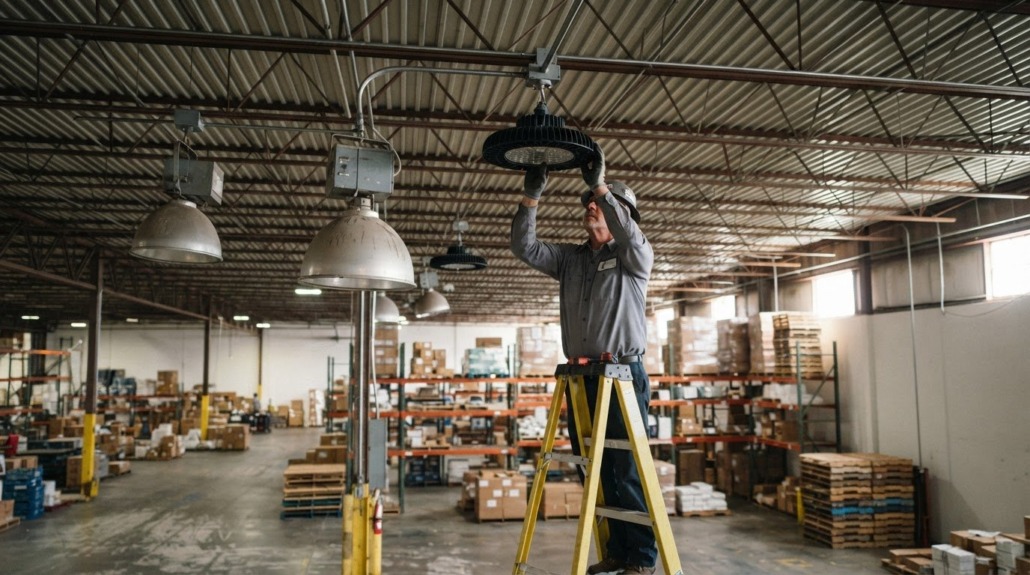
If a commercial lighting retrofit keeps the same switches and operating schedule and adds no controls, use the same annual operating-hours value for each existing and proposed fixture group. That’s the key starting point for how to estimate lighting retrofit projects: calculate each system’s annual lighting use from fixture count, input watts, and operating hours, then divide by 1,000 to get kWh. Use the facility’s actual energy rate to estimate energy-cost savings, and keep that recurring estimate separate from installed project cost and payback.
Fixture count and wattage matter, but an estimate can still miss the mark if it leaves out runtime, labor, ceiling access, disposal, equipment, or maintenance. This guide explains what to gather, how to separate energy savings from project costs, and how to account for maintenance savings alongside the upfront investment. You’ll also learn how to handle areas with different schedules, when new controls change projected hours, and which labor and access details can affect the job. With these inputs, you can build a clearer estimate and see what drives its potential return.
Key Takeaways
- Build a fair energy comparison from fixture count, existing and replacement wattage, actual operating hours, and the facility’s energy rate.
- Keep recurring energy savings separate from installed project cost; include labor, materials, disposal, and other job costs in the estimate.
- Calculate payback using the full investment and realistic energy and maintenance savings, not energy savings alone.
- Account for ceiling height, lift access, work conditions, and fixture grouping when estimating installation time and access costs.
- Organize fixture, runtime, utility, and maintenance details before estimating so assumptions are visible and easier to refine.
How much does a commercial LED retrofit cost per fixture?
There’s no single per-fixture price: building type and location affect labor, access, equipment, and scope. Survey each fixture group, then calculate energy and maintenance costs separately from installation costs. Rebates also vary by location and program.
Survey Fixtures and Site Conditions
Document each existing fixture group before calculating quantities. Record fixture type, location, lamp count, and whether fixtures share a circuit or operating schedule. Note ceiling access and site conditions that could affect the work.
Separate areas that run continuously from those with shorter schedules. A clear inventory helps ensure unlike fixtures aren’t priced or compared as if they were identical.
Gather Existing and Replacement Fixture Inputs
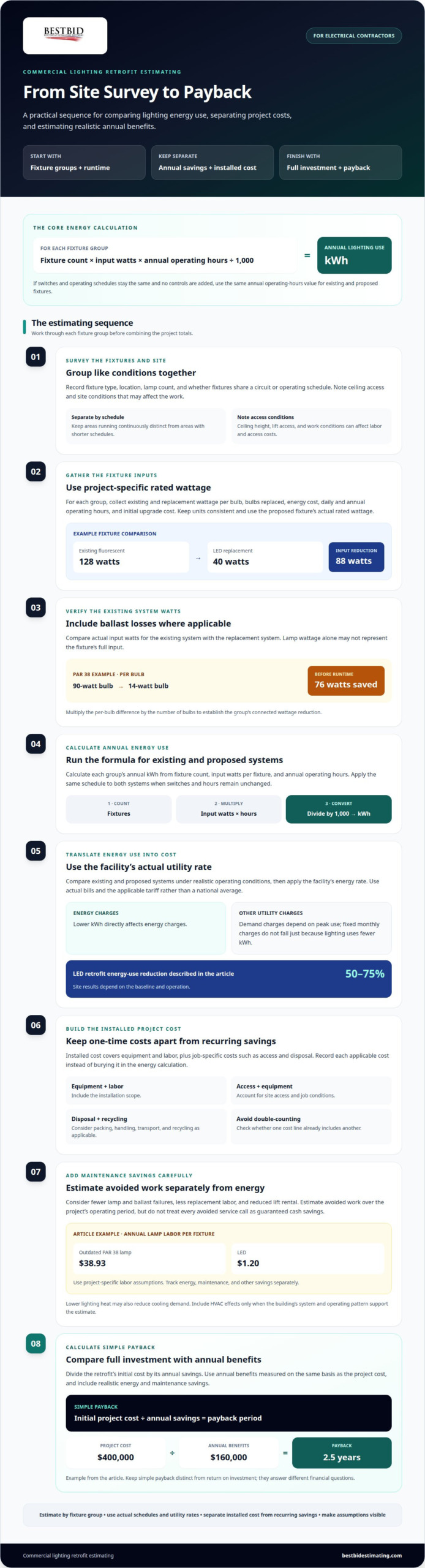
Collect the calculator inputs for each group: existing and replacement wattage per bulb, bulbs replaced, energy cost, daily and annual operating hours, and initial upgrade cost. Keep the units consistent. For example, a comparison can use a 128-watt existing fluorescent fixture and a 40-watt LED replacement, reducing input by 88 watts. Record the proposed fixture’s actual rated wattage, rather than relying on a broad product category.
Account for Wattage and Ballast Losses
Use the existing system’s actual input watts, including ballast losses where applicable, rather than only the lamp’s printed wattage. Compare that figure with the replacement system’s input. A 90-watt PAR 38 bulb replaced by a 14-watt PAR 38 bulb saves 76 watts per bulb before runtime is applied.
Multiply the difference by the number of bulbs to establish the group’s connected wattage reduction. Don’t treat lamp wattage alone as fixture input.
Calculate Annual Energy and Labor
Calculate annual kWh for each fixture group: fixture count multiplied by input watts per fixture and annual operating hours, divided by 1,000. Apply the same schedule to existing and proposed fixtures when switches and hours stay unchanged. Then estimate maintenance costs separately.
One example puts outdated PAR 38 lamp labor at $38.93 per fixture annually, compared with $1.20 for LEDs. Use project-specific labor assumptions for your estimate.
What belongs in an LED retrofit cost estimate?
Separate the one-time installed project cost from recurring annual energy and maintenance savings. For old lamps and ballasts, list handling, disposal, and recycling as distinct costs so they don’t disappear inside an energy calculation.
Separate Installed Costs from Operating Savings
List installation costs separately from operating savings. The installed price covers equipment and labor, plus job-specific costs such as disposal and access. Annual energy savings are a recurring operating estimate, not the retrofit price or a payback result.
Separate demand charges from energy charges: lower kWh directly affects energy charges, while demand charges depend on peak use. Fixed monthly utility charges don’t fall just because lighting uses fewer kWh.
Estimate Energy Savings
Estimate the energy savings by comparing the existing and proposed systems under realistic operating conditions. A basic LED retrofit estimate models energy reduction from lower fixture wattage and runtime, then applies the facility’s utility rate. Use actual bills and the applicable tariff rather than a national average.
Separate fixture groups with different schedules, such as an area running 24/7 and a single-shift workspace. LED retrofits are described as reducing energy use by 50-75%, but site results depend on the baseline and operation.
Include Maintenance and Other Cost Savings
Estimate maintenance savings from fewer lamp and ballast failures, less replacement labor, and reduced lift rental. Count the work avoided over the project’s operating period, but don’t treat every avoided service call as a guaranteed cash saving. Lower lighting heat may also reduce cooling demand, while efficient equipment can affect related operating costs.
Include HVAC effects only when the building’s system and operating pattern support the estimate. Track energy, maintenance, and other savings separately.
Account for Disposal and Recycling
Add disposal and recycling costs for removed lamps and ballasts to the installation estimate. Count each material type and include packing, handling, transport, and recycling as applicable. Treat these as separate examples, not costs to add automatically: check whether one line already includes another to avoid double-counting.
Return on investment and payback period
Use the full project investment and realistic annual benefits to compare returns and recovery time. Keep simple payback distinct from return on investment, since they answer different financial questions.
Estimate Return on Investment
Calculate return on investment by comparing annual savings with total investment. Include energy and maintenance savings, then subtract additional upgrade costs when calculating net savings over a chosen period. Keep the period and savings categories consistent.
Calculate the Simple Payback Period
Divide the retrofit’s initial cost by its annual savings to determine simple payback. The result is the time required for savings to recover the upgrade cost. For example, a $400,000 project with $160,000 in annual benefits has a 2.5-year payback. Use annual benefits measured on the same basis as the project cost, not monthly savings against annual costs.
- Choose a consistent savings basis before comparing alternatives. If the calculation includes energy savings only, label it clearly; adding maintenance savings changes the result. For an LED project, both annual energy savings and reduced maintenance costs can contribute to net benefits. Don’t count an avoided cost twice, such as including replacement labor in maintenance savings and again as a separate operating benefit.
- Use utility charges that reflect actual operating conditions. Energy savings depend on the facility’s energy rate and lighting use, while fixed monthly charges don’t fall with lower lighting consumption. Keep demand charges distinct from kWh-based energy savings. If a tariff includes several charge types, include only changes the lighting project can reasonably affect in the return calculation.
- Review assumptions before using a payback result to make a decision. A longer annual operating schedule can raise modeled energy use and savings when fixture count, wattage, and rate remain unchanged. Maintenance assumptions matter, too: longer lamp life can reduce replacement frequency and labor. Keep existing and proposed operating schedules aligned unless the retrofit changes controls or schedules.
- Present the result alongside its inputs, not as a standalone percentage. Show the upfront cost, annual energy savings, annual maintenance savings, and any additional costs included. Simple payback expresses recovery time; ROI expresses annual savings relative to total investment. Keeping both measures visible helps decision-makers compare projects with different costs and operating benefits.
Ceiling height, access, and lift requirements
Build access into the project cost, not as an afterthought.
- Record the actual ceiling height and fixture locations in each work area. Separate fluorescent troffers within easy reach from high-bay fixtures that require elevated access. Note obstructions, narrow aisles, shelving, and equipment beneath each fixture. These conditions affect where a lift can travel and position safely. A fixture count alone won’t capture the time needed to move and reposition equipment.
- Map the lift route from the building entrance to each lighting zone. Include doorways, floor transitions, aisles, and locations where equipment must be repositioned. In a warehouse, compare routes through storage aisles with those around active work areas. Restricted access can affect installation sequencing and crew time, even when fixture quantities stay the same.
- Identify the equipment needed for the fixture height and work area. A high-bay replacement may require different access planning than a fluorescent troffer in an office. Note whether the planned lift can reach each location and whether multiple areas can be handled in one setup. This ensures the equipment allowance reflects the work, not just the fixture count.
- Estimate rental duration from the installation sequence and site access. Include delivery, setup, repositioning, and removal in the planned rental period. Treat this only as an example of a job allowance, not a universal rate. Actual equipment cost depends on rental terms and the project schedule.
- Separate lift expenses from labor hours in the estimate. Labor covers the crew’s installation work; rental covers access equipment. Keep both visible so the total cost doesn’t hide equipment inside a broad labor figure. Any stated range concerns labor, not lift rental or the complete project cost.
- Group fixtures by access conditions before applying production assumptions. For example, fixtures along one clear aisle may be installed in sequence, while fixtures above obstructions require separate positioning. Record each group’s fixture count, height, route, and equipment needs, then connect those details to labor and rental allowances. This avoids pricing a difficult ceiling area like an open, unobstructed space.
- Review the estimate against the work plan before totaling costs. Confirm that every elevated fixture has an access method and that rental time matches the planned sequence. Keep installation labor, lift rental, and other direct costs distinct. A complete access allowance provides a clearer basis than adding one flat amount across fluorescent and high-bay areas.
Information needed to estimate a lighting retrofit
Start with consistent project inputs, then organize them by fixture group. A clear process for how to estimate lighting retrofit projects makes it easier to compare bids, spot missing scope, and explain the assumptions behind your numbers.
Compare bids using the same fixture quantities, proposed materials, labor scope, access allowances, disposal work, and warranty terms. Permit, electrical-code, and safety requirements depend on project location and scope, so identify applicable local requirements and include related work in the estimate.
Gather Project Information
Collect fixture schedules, site plans, utility bills, maintenance records, and operating schedules. For each group, record fixture type, existing and proposed wattage, quantity, and material requirements. Separate a warehouse operating around the clock from an office using a single-shift schedule.
If new controls change runtime, model proposed hours separately from existing hours rather than carrying the old schedule forward. These details provide the working basis for how to estimate lighting retrofit projects without mixing areas or assumptions.
Check Permits, Codes, and Safety Requirements
Identify the project jurisdiction, work scope, and authority responsible for local permitting before finalizing allowances. Determine which electrical-code requirements apply to the proposed equipment and installation, then include any permit or inspection costs in the estimate. Document ceiling access, energized equipment, occupied areas, and other site conditions that shape the work plan. Don’t assume an existing installation or prior permit settles requirements for a retrofit.
- Use operating records to set defensible runtime assumptions. Lighting-control records or dedicated submetered interval data can help establish actual fixture hours. U.S. utility interval data may show use in hourly or 15-minute intervals, while monthly bills support energy-cost inputs. A business whose bulbs operate 12 or more hours per day needs a different schedule from a lightly used area. Record holidays and planned shutdowns, and account separately for lights that remain on.
- Organize inputs by fixture group before calculating. Annual lighting use depends on fixture count, input watts, and annual operating hours. A modeled example using 4,380 hours per year assumes operation every day across 365 days; replace that assumption when the facility’s schedule differs. Keep material quantities, labor scope, access needs, and proposed controls tied to the same group. This makes omissions easier to spot and bid comparisons more consistent. Improve your electrical estimating workflow with a consistent project-input process.
Best Bid: Best Bid Next Generation
Best Bid Next Generation helps electrical contractors turn takeoff details into organized, detailed project bids. For a lighting retrofit estimate, use on-screen takeoff and automatic conduit and wire length calculations to support quantity work and build a clearer bid. The unlimited license means there’s no extra charge for additional installations. The software helps organize fixture counts, materials, and labor assumptions as you move from site information to a project estimate.
Choose Best Bid when you’re ready to streamline estimating and reduce manual calculations. Best Bid Hybrid Pro and Accura CADD PDF Draw also support electrical estimating and drawing workflows, while the Online School for Electrical Estimating helps develop estimating skills. The right fit depends on how your team handles plans and bid preparation. Visit bestbidestimating.com to learn more.
Turn Your Estimate Into a Clear Project Plan
Knowing how to estimate lighting retrofit projects is a practical starting point. Next, turn your assumptions into a working estimate your team can review, refine, and use to make decisions. Keep the reasoning behind each allowance visible so revisions reflect project changes, not guesswork.
Use the estimate as a planning tool, not just a bid total. It can help align the scope, explain the project’s expected value, and keep conversations with decision-makers focused on the same assumptions. For commercial property investors and business owners—such as those in The Boardroom Mastermind—a rigorous financial breakdown makes it easier to prioritize capital upgrades across a real estate portfolio. As plans develop, update the estimate to reflect the work being considered.
Best Bid serves electrical contractors with estimating tools, including Best Bid Next Generation, Best Bid Hybrid Pro, and Accura Cadd PDF Draw. If you’re ready to discuss your estimating needs, contact Best Bid about your estimate. Take the next step with a clearer plan and confidence in your process.
Frequently Asked Questions
Do I need new hours if I only swap fixtures and keep the same switches?
No. If the retrofit keeps the same switches and schedule and adds no controls, use the same annual-hours assumption for existing and proposed fixtures in each group. Keep areas with different schedules separate.
For example, warehouse aisles and offices shouldn’t share one runtime line if they operate differently. Lighting-control records or dedicated submetered interval data can help refine actual hours instead of applying one building-wide assumption.
Should a utility rebate reduce the contractor’s cost estimate?
Show the rebate separately from the contractor’s project cost. Utility rebate availability varies by location and program, so listing it as a separate incentive keeps the installed estimate transparent. To calculate the customer’s net cost, show the incentive as a distinct deduction from the project total. Don’t use a possible rebate to obscure labor, materials, disposal, or other costs required to complete the retrofit.
What labor rate should I use in an LED retrofit estimate?
Use a rate that matches your estimate’s labor basis, then apply it consistently to the planned technician hours. Distinguish the hourly charge from a loaded technician cost used to calculate labor expense for projects across the U.S. Record what the selected rate includes so labor totals can be compared on the same basis.
What information is needed to estimate a lighting retrofit project?
Gather a fixture schedule, existing and proposed fixture details, operating schedules, utility bills, and maintenance records. Add the applicable tariff, site plans, access conditions, and any proposed controls. Organize those inputs by area or fixture group, especially when a facility includes both warehouse and office spaces. This lets the estimate use distinct operating assumptions and ties each material quantity and labor allowance to the part of the project it covers.
How do you calculate the number and type of replacement light fixtures?
Start with a count by room, fixture type, mounting position, and lighting function. Use the existing layout to check quantities, then identify the proposed fixture type and distribution for each area. Photometric layouts can help assess whether lower-wattage replacements meet lighting needs and avoid over- or under-lighting. In a warehouse, evaluate high-bay locations separately from office fixtures rather than assuming one replacement type suits the entire facility.
How do you estimate labor hours for a lighting retrofit?
Divide the work into fixture groups and estimate installation time for each group based on fixture type, access, wiring, and work sequence. One example allocates 0.50 technician-hour per troffer retrofit kit and 0.75 technician-hour per high-bay replacement. Treat those as project assumptions, not universal production rates. Multiply the estimated hours by the crew’s applicable labor rate, and account separately for lift rental or other access costs.
What are typical lighting retrofit costs per fixture or square foot in the United States?
U.S. estimates vary by scope and by what a figure includes. These measures aren’t interchangeable when working with Best Bid or other contractors. Compare fixture type, materials, labor, disposal, and access scope before evaluating totals.
How do you calculate energy savings and payback for a lighting retrofit?
First compare existing and proposed energy use using fixture quantities, wattage, and actual annual operating hours. Convert the watt-hour difference to kilowatt-hours, then apply the facility’s energy rate to estimate annual energy savings. Keep maintenance benefits separate so their contribution is clear.
For simple payback, divide the installed project cost by annual savings. Exclude fixed utility charges that don’t change with lighting use.