How to Manage Material Price Fluctuations in Bids: A Practical Guide

Your estimate is ready, but the supplier quote may expire before the project is awarded. If material prices move before purchasing, which number should your bid stand behind? Learning how to manage material price fluctuations in bids starts with separating three things: the cost update, the quote’s validity, and who carries the risk if prices change.
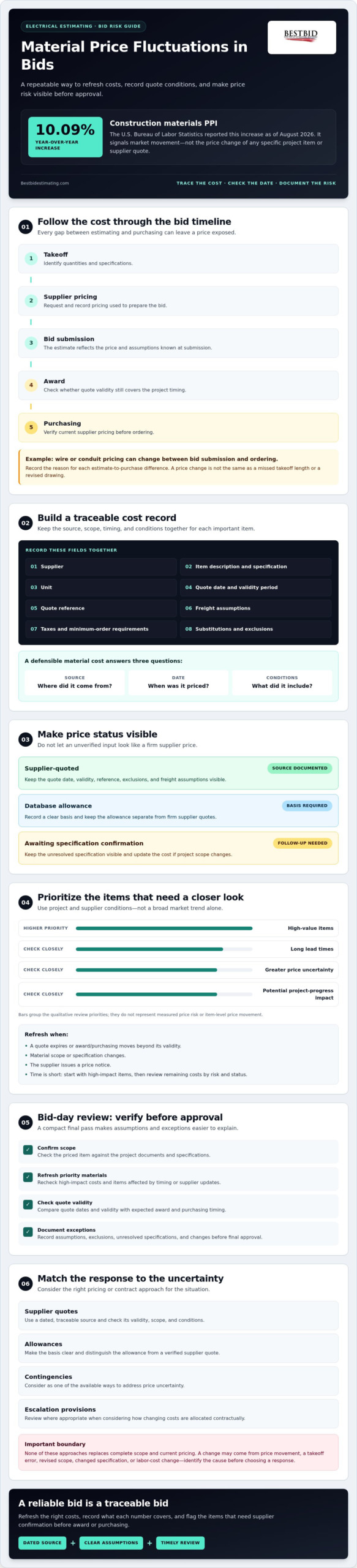
That uncertainty is real. The U.S. Bureau of Labor Statistics’ Producer Price Index for construction materials rose 10.09% year over year as of August 2026.
A stale database price or an undocumented assumption can leave a bid exposed, while manually checking every item takes time and invites errors. A repeatable process is more reliable than a last-minute scramble.
This guide shows you how to refresh material costs, record quote dates and assumptions, and flag items that need supplier confirmation before award or purchasing. You’ll also compare practical ways to address price risk, from clear bid qualifications to escalation provisions where appropriate. The goal is a bid your team can trace, explain, and update with confidence.
Key Takeaways
- Learn how to manage material price fluctuations in bids with a repeatable cost-refresh process, not outdated database prices.
- Record the supplier, item description, unit, quote date, validity, exclusions, and freight assumptions together so each cost has a clear source.
- Choose between quotes, allowances, contingencies, and escalation provisions based on the type of uncertainty. None is a substitute for complete scope and current pricing.
- Use a bid-day review to confirm scope, refresh priority materials, check quote validity, and document exceptions before final approval.
- Compare pricing tools by update sources, database control, auditability, takeoff flow, and training to find a process your team can maintain.
Why Material Price Fluctuations Put Electrical Bids at Risk
A material price fluctuation is a change in an item’s cost between estimating, bid submission, award, and purchasing. The estimate may be sound on bid day but no longer match the supplier’s price when the contractor is ready to order. The difference can affect the material total, expected margin, or both.
A defensible bid ties each material cost to a dated, traceable source, so the team can see what was priced, when it was priced, and under what conditions. That record also helps distinguish a price change from a takeoff error, revised scope, changed specification, or labor-cost change. Each has a different cause and requires a different response.
For a broader look at contractual approaches to changing costs, watch this video from Baker Donelson:
Where price changes enter the bid timeline
Follow each cost from takeoff through purchase order. At takeoff, the estimator identifies quantities and specifications. Supplier pricing is then requested and used to prepare the bid.
Award may come later, followed by purchasing. Every gap between these steps creates uncertainty: a quote may expire, a supplier may revise terms, or the specified item may no longer match what is available.
For example, if wire or conduit pricing changes after the bid is submitted but before ordering, the original material total may no longer reflect the current supplier quote. That differs from a missed length in the takeoff or a revised drawing. Record the reason for each change rather than treating every estimate-to-purchase difference as price movement. Contract terms may also address changing costs. An escalation clause is one concept to understand when reviewing risk allocation.
Which material costs deserve closer attention?
Prioritize items with high value, long lead times, greater price uncertainty, or the potential to affect project progress if unavailable. Don’t assume every material will rise or that a broad market trend applies to a specific quote. Verify current project and supplier conditions.
Label each cost by status: supplier-quoted, database allowance, or awaiting specification confirmation. Check a quote’s date, validity, exclusions, and freight assumptions. Give an allowance a clear basis, and flag an unconfirmed specification for follow-up. Separating these inputs is a practical first step in how to manage material price fluctuations in bids without confusing uncertain costs with verified prices.
Build a Reliable Material Price Baseline Before Bid Day
A dependable baseline is more than a unit cost in an estimate. It records where the number came from, what it covers, and when it needs another look. Use the same sequence for each bid: identify the pricing source, date the cost, capture quote limits, then refresh priority items as submission approaches.
Create a traceable cost record for each key item
For each important material, keep the supplier, item description and specification, unit, quote date, validity period, and quote reference together. Add freight, taxes, minimum-order requirements, substitutions, and exclusions when they apply. These details help confirm that the estimator’s assumptions match both the supplier’s offer and the project documents.
Keep firm supplier quotes separate from database allowances and items awaiting specification confirmation. This prevents an allowance from appearing to be a verified quote and keeps unresolved substitutions visible for follow-up. If the project scope changes, update the record rather than carrying forward a cost tied to an earlier specification.
Set a practical price-refresh routine
Set refresh triggers before the bid is under pressure. Recheck an item when its quote expires, the award or purchasing date moves beyond the quote’s validity, the material scope or specification changes, or the supplier issues a price notice. If time is short, start with high-impact items, then review remaining costs according to their risk and status.
Pricing data in estimating software can help refresh costs efficiently, but it does not replace confirmation of a live supplier quote. Integrated pricing can support the workflow; the estimator still needs to verify the project-specific item, terms, and availability with the supplier. For an example of how adjustments may be addressed in certain federal contracts, review the Economic Price Adjustment clause and confirm whether it applies to the contract at hand.
A simple ownership rule keeps the routine moving: assign someone to follow up on expiring quotes, record supplier updates, and flag unresolved exceptions for estimate review. That turns how to manage material price fluctuations in bids into a repeatable practice instead of a bid-day scramble. Teams comparing electrical estimating tools can look for pricing workflows and database controls that support this kind of traceability.
Compare Quotes, Allowances, Contingencies, and Escalation Options
A current quote, an allowance, a contingency, and an escalation provision serve different purposes. A quote supports the estimate with supplier pricing. An allowance or contingency addresses a defined estimating uncertainty.
Escalation language concerns how certain cost changes may be allocated under the contract. These options aren’t interchangeable, and none should conceal incomplete scope or stale pricing.
Choose the option that fits the uncertainty and the bid documents. Use the comparison below to identify what to verify before submission.
| Option | What it covers | When it may fit | What to verify |
|---|---|---|---|
| Supplier quote | Pricing and terms for identified materials | Specifications and quantities are clear enough for supplier pricing | Expiration, exclusions, availability, substitutions, and delivery assumptions |
| Allowance | A stated placeholder for a defined item or scope that isn’t fully priced | Bid documents and the customer’s process permit an allowance | Basis, included scope, adjustment process, and approval requirements |
| Contingency | Identified uncertainty the estimate may reasonably need to account for | A specific risk remains after scope review and price checks | What risk it addresses, how it’s calculated, and whether it duplicates other coverage |
| Escalation provision | Contractual treatment of specified cost changes | The customer and contract terms allow an adjustment mechanism | Trigger, covered materials, timing, documentation, and legal review |
When a current supplier quote is the stronger basis
When the material specification and quantity are clear, request supplier pricing rather than relying on a broad allowance. Read the quote carefully: a stated price may be limited by its validity period, exclusions, delivery terms, or availability. Check whether substitutions are permitted and whether the quoted item matches the project documents.
A quote records pricing under stated terms. It doesn’t promise that supply or price will remain unchanged beyond them.
How to treat allowances and escalation language
Use an allowance only when the bid documents and customer process permit it, and identify exactly what remains unpriced. A contingency should address a known uncertainty, not missing scope, unverified quantities, or expired quotes. Keeping those distinctions clear makes the estimate more transparent and later review more straightforward.
Escalation language is a contract matter, not a substitute for sound estimating. Its suitability depends on the contract terms, customer requirements, and appropriate legal review. Don’t assume a clause is accepted or appropriate for every bid. Teams strengthening their estimating and risk-management practices can also explore training through Best Bid Academy. This process-focused approach is central to how to manage material price fluctuations in bids: verify what you can control, then clearly identify any remaining contractual risk.
Download as HTML
Use a Bid-Day Workflow to Verify Changes and Document Assumptions
A final material-cost review works best as a defined handoff, not a last-minute search through email. Set a cutoff for checking priority items, assign each follow-up an owner, and record unresolved pricing assumptions where the estimator, approver, and purchasing team can find them.
A final material-cost check before submission
Before submitting the bid, compare high-impact line items with current supplier quotes and the latest estimate revision. Check that quantities, units, specifications, and approved substitutions still match the takeoff and project documents. A quote for the wrong conductor type or unit of measure can be current and still produce an inaccurate total.
Use this short review:
- Confirm the material scope against the latest drawings and specifications.
- Refresh priority costs and check that each quote remains valid for the expected award or purchase timing.
- Flag expired quotes, exclusions, and unresolved scope questions for review.
- Record exceptions in internal notes and, where appropriate, state relevant assumptions clearly in the customer-facing bid.
If a key quote has expired or a specification is unresolved, raise it before submission when the schedule allows. If it can’t be resolved in time, don’t present an assumption as a confirmed price. Make the remaining uncertainty visible and route it to the person responsible for final approval.
Preserve the handoff from estimate to purchasing
The estimate should give purchasing enough context to act without reconstructing the estimator’s work. Save quote references, dates, supplier contacts, assumptions, and exceptions with the estimate record. Identify prices that need reconfirmation before an order is placed, especially if award or procurement timing has moved beyond the supplier’s stated terms.
Assign ownership so follow-up doesn’t fall between roles: one person contacts suppliers, another records updates in the pricing database, the estimator reviews cost changes, and an authorized approver signs off on the final bid. In a smaller team, one person may hold several roles, but each responsibility should still be explicit.
Bid-day checklist: Current quotes support priority costs, assumptions are clearly recorded, and the estimate preserves a reviewable trail from takeoff to purchasing.
A consistent workflow is a practical foundation for how to manage material price fluctuations in bids. If your team is reviewing its electrical estimating process, explore Best Bid’s electrical estimating resources.
Choose Tools That Keep Electrical Material Pricing Current
The right setup depends on your bid volume, team size, and how often material costs need review. A spreadsheet is easy to adapt, but updates and quote references can end up in different files or depend on manual checks. Standalone estimating tools can centralize takeoff and costs, while an integrated electrical estimating workflow can connect quantity takeoff, pricing, and estimate revisions more closely.
Compare tools against the work your team needs to do. A useful system should make it easier to refresh costs and trace their source without taking control away from the estimator.
What to evaluate in estimating software
Review how each option handles these practical requirements:
- Pricing sources: Identify where costs come from, how updates are made, and whether supplier quotes still need direct confirmation.
- Database control: Check whether estimators can manage and review cost records rather than treating every price as fixed.
- Auditability: Confirm that quote dates, assumptions, and estimate revisions can be traced when someone asks how a number was built.
- Takeoff-to-estimate flow: Assess whether quantities and material costs remain connected as drawings, specifications, or estimate revisions change.
- Implementation basics: Consider user training, support, and backup practices alongside pricing features. A tool only helps if the team can use it consistently and protect its working records.
For teams evaluating how to manage material price fluctuations in bids, these criteria help distinguish a faster update process from one that is also reviewable. Integrated pricing can reduce manual steps, but it doesn’t replace confirming project-specific costs and supplier terms.
Where Best Bid fits into this workflow
Best Bid provides electrical estimating software with real-time pricing integration through NetPricer. Treat that integration as pricing support for the estimator’s refresh process, not as a guarantee that a supplier will honor a particular price or that every required item and data source is covered. Verify current functionality and data coverage for your needs before relying on an integration.
Best Bid also offers an estimator-controlled database and built-in on-screen takeoff, useful for teams that want to manage costs and quantities within their electrical estimating workflow. Check that any tool you consider fits your procedures for reviewing quote validity, updating estimates, and handing confirmed information to purchasing.
Ready to compare an electrical-focused workflow with your current process? Explore Best Bid electrical estimating software and assess how its pricing support, database control, and takeoff tools align with your team’s bid review process.
Make Your Next Bid Easier to Verify
Price changes are easier to manage when every material cost has a source, date, and clear set of assumptions. Refresh priority items as the bid progresses, distinguish supplier quotes from allowances, and document unresolved risks before they become purchasing surprises. That repeatable process is the foundation of how to manage material price fluctuations in bids with confidence.
Electrical estimating tools can help organize the workflow, but supplier verification and estimator review still matter. Best Bid combines real-time pricing integration through NetPricer with an unlimited, user-controlled database. Its founder, Steve Griffin, brings more than 50 years of trade and estimating experience to the field.
Ready to see how a purpose-built electrical estimating workflow could fit your team? Explore Best Bid electrical estimating software and take the next step toward bids your team can update, explain, and stand behind.
Frequently Asked Questions
How do you protect a bid when material prices change?
Protect a bid with dated supplier quotes and traceable cost records for high-impact materials. Before submission, confirm each quote’s validity, exclusions, delivery assumptions, and fit with the project specifications. Refresh prices if quotes expire, the scope changes, or award timing shifts. Document unresolved assumptions clearly, and check any proposed allowance or escalation language against the bid documents, contract requirements, and appropriate professional advice.
How often should material prices be updated in an estimate?
There’s no single refresh interval that works for every project or material. Recheck costs when a supplier quote expires, quantities or specifications change, the bid timeline extends, or a supplier advises of a price change. Start with high-value or schedule-sensitive items, then review other costs according to their risk. Record the source and date of each update so reviewers can assess whether the estimate remains current.
Should contractors use an allowance for materials with changing prices?
An allowance may be appropriate when a material selection or part of the scope isn’t fully defined, but only if the bid documents and customer process permit it. State what the allowance covers and identify exclusions or unresolved details. Don’t use an allowance to hide missing scope or unverified pricing. Before proposing allowance language, review the contract requirements and seek appropriate advice about how it should be presented.
What should a supplier material quote include before I use it in a bid?
Confirm that the quote matches the project’s material specifications, quantities, units, and delivery assumptions. Record the supplier, quote date, validity period, exclusions, freight terms, and any conditions for substitutions or availability. Check whether the price depends on other supplier terms. If an important detail is unclear, ask the supplier to clarify it before relying on the quote in a submitted bid.
Can estimating software automatically prevent losses from material price changes?
No. Estimating software can organize costs, connect takeoff quantities to estimates, and support price updates, but it can’t remove market uncertainty or guarantee supplier availability and pricing. It also doesn’t replace checking quote terms against project documents. Use software as part of a controlled process: verify critical costs, record assumptions, refresh prices when needed, and communicate unresolved risks before finalizing the bid.
How can electrical contractors handle expired supplier quotes on bid day?
Contact the supplier to confirm current pricing, availability, and terms as soon as you identify an expired quote. If you can’t get confirmation before submission, follow the bid instructions for documenting assumptions or exclusions. Don’t present expired pricing as current without qualification. Flag the item for review and keep the supplier communication with the estimate so purchasing knows what must be reconfirmed before ordering.
What is the difference between a contingency and an escalation clause?
A contingency is an estimate or project provision for identified uncertainty, subject to the bid and contract rules. An escalation clause is contract language that addresses specified price changes under defined conditions. They serve different purposes and aren’t automatically appropriate for every bid.
Review project documents and get qualified contract advice before including either. A contingency shouldn’t conceal incomplete scope or outdated pricing, and escalation terms need clear contractual support.
How can I track material price changes across estimate revisions?
Keep a revision record for each changed item, showing the previous and updated source, quote date, quantity, unit, and reason for the change. Preserve supplier references and distinguish updated pricing from revised scope or a corrected takeoff. A controlled database and consistent review process help estimators explain changes to owners, project managers, and purchasing staff while maintaining a clear trail from the original estimate to the current version.