
Why Balance Is the Foundation of Every Great Electrical Estimate
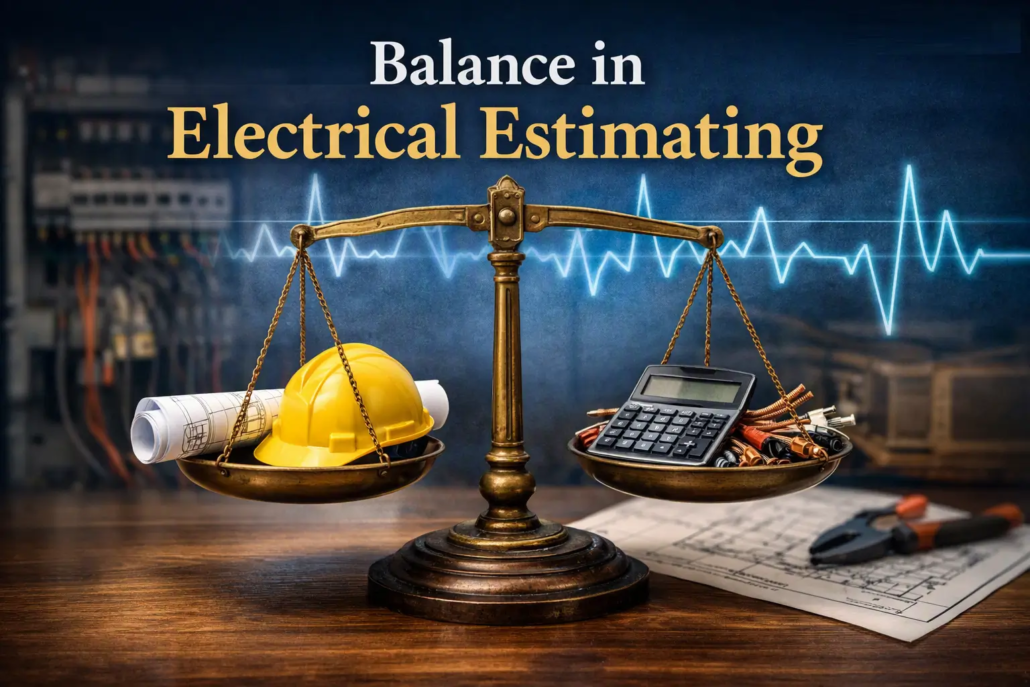
consistently win profitable work from those who don’t.
By Steve Griffin · Founder, Best Bid Electrical Estimating Software
· July 23, 2026 · 8 min read
📖 Part of the Complete Series
This article is Part 1 of 30 in The
Art of
Balance in Electrical Estimating Software — the complete philosophy guide by Steve Griffin. Read all 30
sections in one place.
The Tension at the Heart of Every Bid
Electrical estimating is a field built on tension. Every decision an estimator makes is a negotiation between
competing priorities: speed versus accuracy, detail versus simplicity, cost versus capability. After decades in
the industry — both estimating and designing estimating software — one truth becomes clearer than any other:
balance is the foundation of everything.
Balance is not a feature. It’s not a button. It’s not a setting buried in a menu. Balance is a
philosophy. It’s the lens through which every design decision must pass. It’s the quiet force that
determines whether software feels natural or frustrating, whether an estimate feels smooth or chaotic, whether a
contractor trusts the number or doubts it.
Estimating is a world defined by constraints. Time is limited. Labor is expensive. Materials fluctuate.
Competition is fierce. Mistakes are costly. And in the middle of all these constraints stands the estimator — a
person who must produce a number that is both fast and accurate, both competitive and profitable, both simple
and detailed. That tension is where balance lives.
Balance is the art of giving the estimator exactly what they need — no more, no less.
The Eight Weights on the Scale
Every single decision in estimating software design comes down to one question: where is the balance
point? It is the constant weighing of forces pulling in opposite directions:
- What helps the estimator
- What slows them down
- What increases accuracy
- What adds unnecessary complexity
- What saves money
- What costs money
- What is essential
- What is fluff
Every feature ever added to estimating software began as an answer to one of these questions. The ones that
lasted passed the balance test. The ones that didn’t became clutter — and clutter is the silent killer of
estimating workflow.
What Happens When the Scale Tips
Lean too far in any direction and the software becomes unusable. This isn’t theory — it’s the
observable pattern of every estimating software company that has launched, struggled, and either adapted or
disappeared over the last 50 years.
| When software tips toward… | The result is… | The contractor loses… |
|---|---|---|
| Too many features | Bloated, slow, expensive software | Time and workflow momentum |
| Too few features | Weak, incomplete estimates | Accuracy and confidence |
| Too much detail | Estimates that take days, not hours | Bid opportunities |
| Too little detail | Numbers that miss real costs | Profit margin |
| Too much freedom | Inconsistent, unreliable output | Estimator confidence |
| Too much rigidity | Software that fights the job | Flexibility on unique projects |
| Too much automation | Estimator loses judgment and control | Understanding of their own numbers |
| Too little automation | Manual entry errors multiply | Speed and consistency |
Balance is the art of threading the needle through all of these extremes simultaneously. It’s why building
great estimating software is genuinely hard — and why estimators can instantly feel when it’s wrong, even if
they can’t always articulate why.
Why Balance Is Never a One-Time Achievement
Balance is not something you achieve once. It’s something you maintain. It’s something you revisit.
It’s something you refine. As the industry changes — as labor costs change, as material costs change, as
technology changes — the balance point moves.
Good software adapts. Bad software calcifies.
This is the reason some estimating systems survive decades while others disappear in a year. It’s the
reason some contractors swear by their software while others swear at it. Software that is balanced at launch
but never updated slowly loses its alignment with the real world. Prices shift. Labor agreements change. New
material categories emerge. Code requirements evolve. The balance point of 2005 is not the balance point of
2026.
Key Principle
Balance is the foundation of adaptability. Software that maintains its balance through changing conditions
survives. Software that doesn’t becomes a monument to the year it was built — still running, but
increasingly out of step with the contractors trying to use it.
The Practical Reality for Estimators Right Now
If you’re an electrical estimator or contractor reading this, you already know what imbalance feels like.
You’ve felt it when your software makes you click through five screens to change a labor rate. You’ve
felt it when an assembly doesn’t cover the actual conditions on the job. You’ve felt it when the number
comes out and you don’t trust it — but you can’t put your finger on exactly why.
That feeling is imbalance. And it has a real cost.
Estimators who fight their software add time to every bid. They add padding to every number. They second-guess
assemblies. They verify and re-verify because the system hasn’t earned their trust. That lost time and lost
confidence directly translates to fewer bids submitted, thinner margins, and jobs lost to competitors who have a
system working with them instead of against them.
Balance Is the Difference Between…
- A tool and a burden
- A solution and a problem
- A system and a mess
- A win and a loss
Balance is the core principle that guides every other principle in electrical estimating. It is the anchor. The
compass. The foundation. And it is the starting point for everything that follows across all 30 sections of this
guide.
The deeper you go into estimating — the more jobs you bid, the more software you evaluate, the more contractors
you talk to — the more you realize that balance is not just important. It’s everything.
Frequently Asked Questions
What does “balance” mean in electrical estimating?
Balance in electrical estimating means giving the estimator exactly what they need — no more,
no less. It is the constant negotiation between speed and accuracy, detail and simplicity, cost and
capability. An estimate that is too detailed is too slow to be competitive. An estimate that is too fast is
too inaccurate to be profitable. Balance is threading the needle between these extremes.
Why do estimators struggle with electrical estimating software?
Most estimators struggle because their software has broken the balance. Either it is
overloaded with features that slow the workflow, or it is too simplified to produce accurate numbers. When
software leans too far in any direction — too complex, too rigid, too automated, too manual — estimators fight
the system instead of using it. The best software disappears into the workflow.
How do you balance speed and accuracy in electrical bidding?
Practical accuracy — not mathematical perfection — is the goal of every electrical bid.
Software must allow an estimator to move fast enough to stay competitive while maintaining enough precision to
protect profit margins. This means smart assemblies, reliable defaults, and flexible overrides — all
calibrated to the pace of real bidding, not laboratory conditions.
What happens when electrical estimating software is out of balance?
When software tips too far toward complexity, estimators abandon it and go back to
spreadsheets or guesswork. When it tips too far toward simplicity, they start padding numbers to cover
uncertainty. Either way, the contractor loses: they underbid and lose money, or they overbid and lose the job.
Balance protects both the estimate and the business.
Why has Best Bid Electrical Estimating Software lasted 50+ years?
Best Bid has survived five decades because its core philosophy has always been balance — not
chasing every new technology trend, not adding features for the sake of a brochure, but maintaining the
equilibrium between what helps and what hinders. That philosophy, rooted in 50+ years of real-world estimating
experience, is what separates lasting software from software that disappears in a year.