Is Cloud Estimating Software Worth the Cost
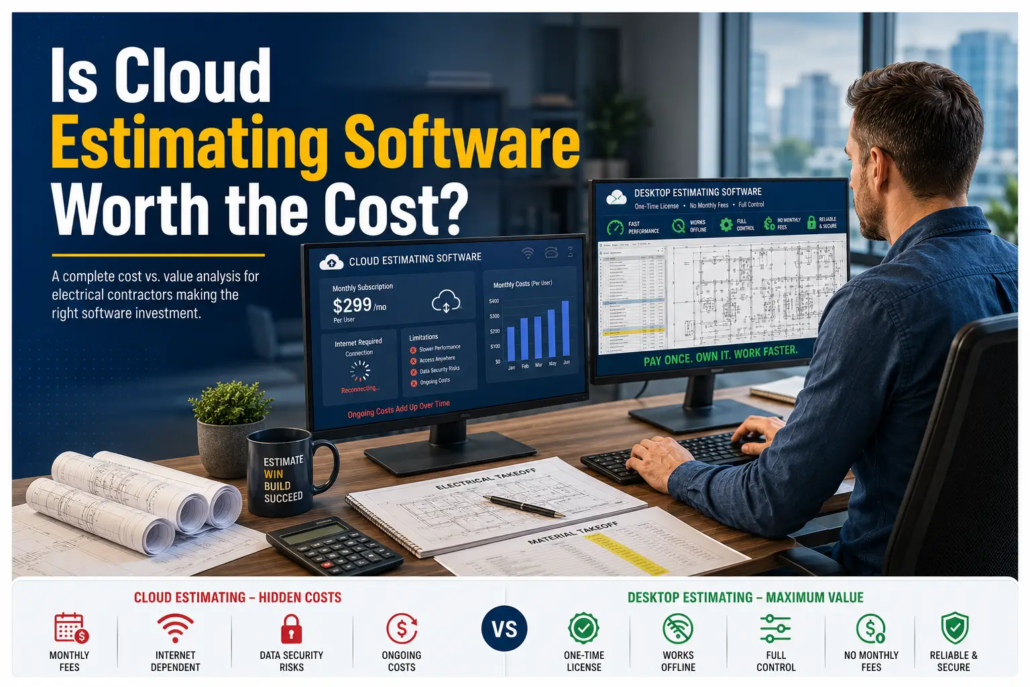
Quick answer: Cloud estimating software offers excellent collaboration and accessibility for electrical contractors. However, many businesses find cloud tools are not worth the recurring monthly subscriptions and reliance on constant internet access. Desktop solutions like Best Bid Next Generation provide faster workflows and full data ownership without ongoing fees.
Electrical contractors face a critical choice when upgrading their bid management systems. Choosing the right software can streamline your operations, but picking the wrong platform drains your budget and slows down your workflow.
Cloud estimating software is heavily marketed across the industry right now. Vendors promise seamless updates and remote access.
Yet, many seasoned estimators hesitate to move their operations entirely online. They worry about expensive monthly subscriptions, constant internet reliance, and losing control over their proprietary data. Determining if cloud software is truly worth the investment requires weighing these modern benefits against the practical realities of electrical contracting.
Why do electrical contractors hesitate to use cloud estimating platforms?
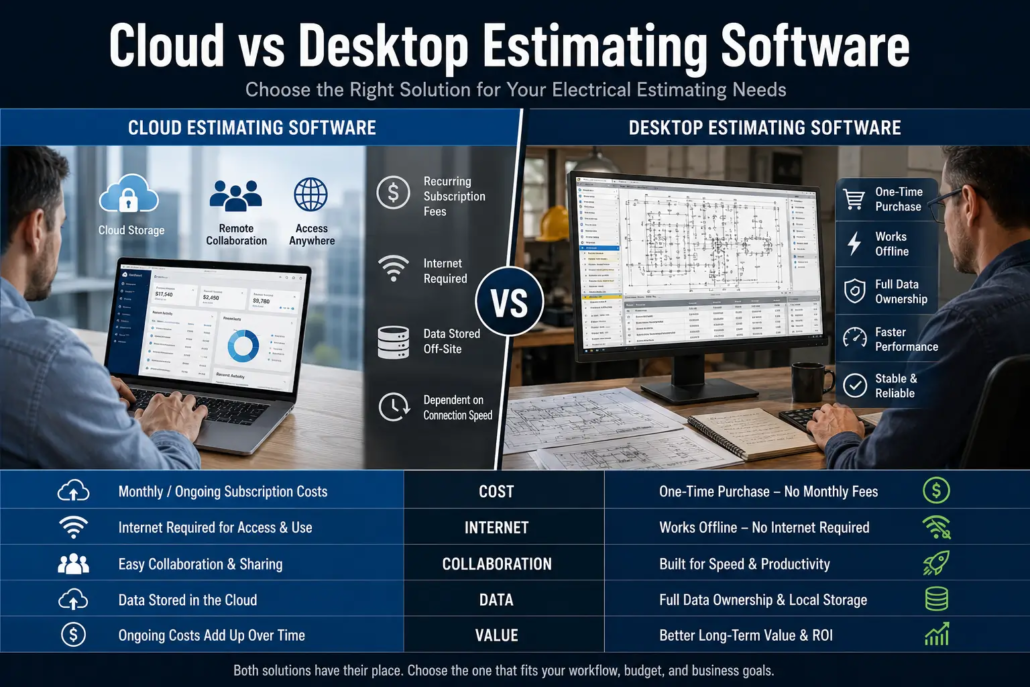
Many contractors prefer to avoid ongoing monthly subscriptions. Traditional methods or one-time purchase software offer predictable expenses. In contrast, cloud platforms trap businesses in perpetual payment cycles.
Reliance on internet connectivity presents another major hurdle. If the job site lacks cellular service or the office internet goes down, cloud software locks estimators out of their active bids. Furthermore, users often feel they never fully own or control their data when it sits on a third-party server.
Despite these valid concerns, basic alternatives like spreadsheets have severe limitations. Excel will only take you so far. While spreadsheets provide basic reports and material tracking, they do not allow quick estimating changes or automatically maintain current pricing.
What are the benefits of using cloud estimating software?
Cloud platforms do offer specific operational advantages. The primary benefit is accessibility. Estimators can open a web browser anywhere to work on a bid, enabling real-time collaboration across multiple office locations.
Cloud platforms also streamline certain data management tasks. Estimators can generate reports quickly and share them via secure links. Revisions happen instantly, which prevents team members from working on outdated files.
How does electrical estimating differ from general construction?
Electrical estimating goes far beyond simple item counts. A large portion of the estimating process requires carefully reading project notes and fully understanding complex specifications and schedules. Reading and comprehending the entire project scope often takes just as long as the actual takeoff.
Basic estimating services usually charge between $150 and $750 for simple counting tasks. These services might count items and average raceway distances, or scale home runs without digging into the nuances. Detailed takeoffs require a deeper understanding of the project, which is why specialized software is necessary for accurate bidding.
How does Best Bid Next Generation compare to cloud alternatives?
Contractors looking for high-speed workflows without the drawbacks of cloud subscriptions often turn to Best Bid Next Generation. This platform eliminates recurring monthly fees while offering capabilities that rival or exceed expensive enterprise systems.
When evaluating software for a single-location contractor, the differences in functionality and price become clear. Best Bid Next Generation ranks highly for its five-star Workflow Speed and five-star Revision Handling. It features built-in On-Screen Takeoff (OST), whereas competitors like McCormick, Trimble Accubid, and ConEst IntelliBid do not include this natively.
The cost disparity is also significant. A five-user license for Best Bid Next Generation costs approximately $2,500 as a one-time payment. In contrast, McCormick ranges from $15,000 to $40,000. ConEst IntelliBid costs between $20,000 and $60,000. Trimble Accubid carries the highest overhead for small shops, running between $25,000 and $75,000.
Best Bid Next Generation delivers the highest speed, flexibility, and cost efficiency combination in this comparison.
Making an informed software decision for your business
Deciding if cloud software is worth it ultimately depends on your individual priorities. If real-time remote collaboration is your only goal, a cloud subscription might make sense. However, if you prioritize data ownership, fast workflows, and eliminating recurring overhead, a robust desktop application provides far more long-term value.
Detailed project understanding remains the most critical factor in any estimating method. Modern solutions like Best Bid Next Generation empower you to manage those details efficiently without holding your budget hostage.
Which electrical estimating software offers the best value?
When comparing electrical estimating software, specific features dictate the overall value. Consider the differences between top industry options for a five-user setup:
- Best Bid Next Generation: Costs approximately $2,500 as a one-time purchase. Best Bid Next Generation features a built-in On-Screen Takeoff (OST), five-star workflow speed, and incredibly high database flexibility.
- McCormick: Costs between $15,000 and $40,000+. McCormick provides strong structured estimating but lacks a built-in OST.
- ConEst IntelliBid: Costs between $20,000 and $60,000+. ConEst IntelliBid offers a powerful database but involves a much more complex workflow.
- Trimble Accubid: Costs between $25,000 and $75,000+. Trimble Accubid functions as an enterprise-grade system but carries the highest overhead for small shops.
Choose Best Bid Next Generation if low cost and high flexibility matter more to your business than expensive enterprise-grade overhead.
Frequently Asked Questions (FAQ)
Software costs vary based on the pricing model. Cloud subscriptions charge recurring monthly fees that accumulate over time. One-time purchase options, like Best Bid Next Generation, cost around $2,500 for a five-user license with no ongoing fees.
Cloud estimating software requires a constant internet connection to function and save data. Desktop or hybrid software allows you to work entirely offline, ensuring you can complete estimates from any location regardless of connectivity.
The learning curve depends on the platform's complexity. Best Bid Next Generation features a low-to-medium learning curve designed specifically for electrical contractors, whereas enterprise systems like Trimble Accubid require extensive, time-consuming training.
Join our Online School for Electrical Estimating and start learning the skills that pay dividends for a lifetime.
Still relying on spreadsheets for your bids?
Call 800-941-7028 or schedule a live demo to see how modern electrical estimating software can transform your workflow.